In an era where data is often described as the “new oil,” the risks associated with storing massive amounts of Personally Identifiable Information (PII) indefinitely have never been higher. For the U.S. government, managing the E-Verify system—which contains sensitive data for millions of workers—requires a delicate balance between administrative necessity and privacy protection.
To address this, U.S. Citizenship and Immigration Services (USCIS) follows a strict mandate to purge older data, specifically targeting records that have surpassed a decade of existence.
The NARA Mandate: Schedule N1-566-08-7
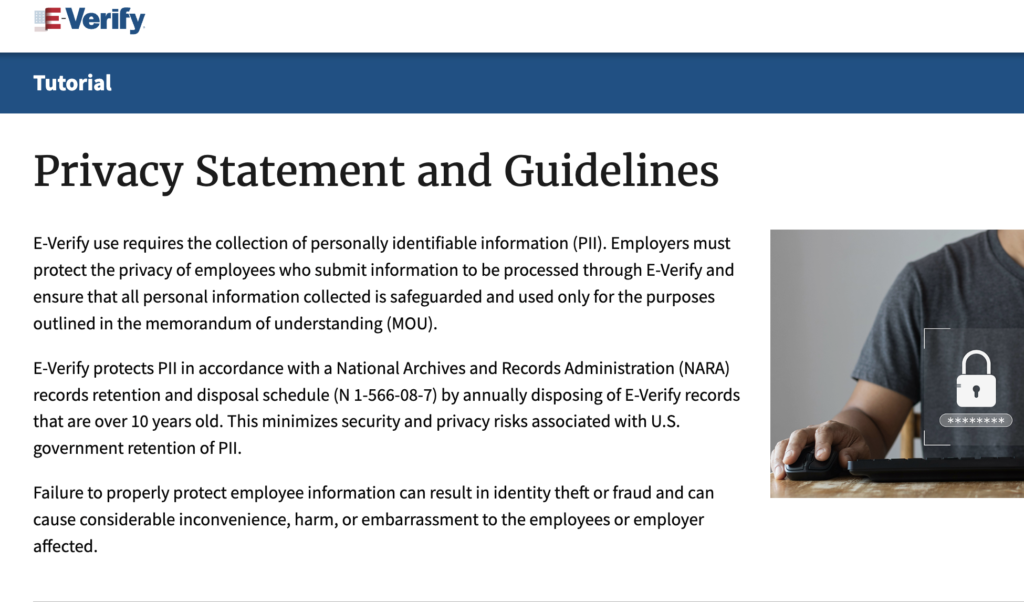
The foundation of E-Verify’s data hygiene policy is the National Archives and Records Administration (NARA) records retention and disposal schedule (N1-566-08-7). Established in 2008, this schedule serves as a legal roadmap for how long the government is permitted to hold onto employment eligibility records.
Under this schedule, USCIS is required to dispose of E-Verify records that are more than 10 years old. This is not a discretionary “best practice” but a formal requirement. Every year, typically in early January, the system identifies all cases that reached their 10-year mark as of the end of the previous calendar year and permanently deletes them from the E-Verify database.
Minimizing the “Blast Radius” of PII
The primary driver behind this annual disposal is the minimization of security and privacy risks. In cybersecurity, the “blast radius” refers to the potential damage caused by a data breach. By deleting records that are no longer legally or operationally necessary, the government effectively shrinks this radius.
Retention of PII—such as Social Security numbers, names, and dates of birth—creates a perpetual target for identity thieves and state-sponsored actors. By ensuring that the “government’s memory” of a specific employment verification event only lasts 10 years, USCIS aligns itself with the Privacy Act of 1974 and the principle of “data minimization.” This principle dictates that organizations should only keep the personal data they need for as long as they need it.
What This Means for Employers: The Historical Records Report
While the disposal process is a win for consumer privacy, it creates a compliance responsibility for businesses. Because the records are permanently deleted and cannot be recovered by USCIS, employers who might face future audits (such as those from ICE or the Department of Labor) must take proactive steps.
To bridge this gap, E-Verify provides a window each year for employers to download a Historic Records Report. This report includes:
-
Company names and locations.
-
Initiated dates and verification case numbers.
-
Employee names and case resolution statuses.
Crucially, the report contains the “paper trail” of compliance without necessarily retaining the most sensitive employee data (like full SSNs) in a way that creates new risks.
The Bottom Line: Compliance Meets Privacy
The E-Verify disposal schedule is a prime example of how automated data lifecycle management can protect citizens. By adhering to NARA Schedule N1-566-08-7, the government acknowledges that the value of holding onto a 10-year-old verification record is outweighed by the risk of that data being compromised.
For businesses, this serves as a reminder that true compliance includes the safe disposal of data. Just as the government purges its records to protect PII, modern organizations should utilize privacy management software to ensure they aren’t holding onto “toxic data” that could lead to liability long after its usefulness has expired.
