Know what’s on your site before a plaintiff’s firm does
A free privacy audit shows which cookies, pixels and trackers are running — and which ones commonly appear in privacy claims.
Digital sovereignty has spent years sounding more like a political ambition than a measurable compliance standard.
European policymakers regularly spoke about reducing dependence on foreign technology providers, retaining control over sensitive data, developing domestic cloud capacity, and preventing critical infrastructure from becoming overly reliant on companies outside the European Union.
Those principles are now being translated into something far more consequential: procurement criteria, assurance levels, vendor scoring systems, conformity assessments, and independent audits.
EU Digital Sovereignty Is Becoming a Compliance Test for Cloud and AI Vendors
The European Union’s emerging approach to cloud and AI sovereignty gives public authorities a structured way to examine who controls a technology provider, where data is processed, which laws can reach that data, how dependent the service is on non-EU suppliers, and whether the provider can continue operating during political, legal, or commercial disruption.
This is not simply another data residency requirement.
The EU is developing a broader test of technological control. It asks whether European customers remain dependent on foreign decision-makers, software suppliers, infrastructure operators, support personnel, legal jurisdictions, and AI developers even when a cloud provider promises to store customer data inside Europe.
For cloud providers, AI developers, software vendors, government contractors, and regulated enterprises, this changes the compliance conversation. Data localization alone will no longer be enough to establish sovereignty. Organizations may need to demonstrate control across the entire technology and supply-chain lifecycle.
Europe Is Turning Sovereignty Into a Procurement Standard
The European Commission defines technological sovereignty around Europe’s ability to make independent choices in the digital economy while maintaining control over important technologies, infrastructure, and data.
That concept has now influenced a major European cloud procurement program.
Through the Cloud III Dynamic Purchasing System, the Commission awarded a sovereign cloud contract valued at approximately 180 million euros to four providers:
- Post Telecom
- STACKIT
- Scaleway
- Proximus
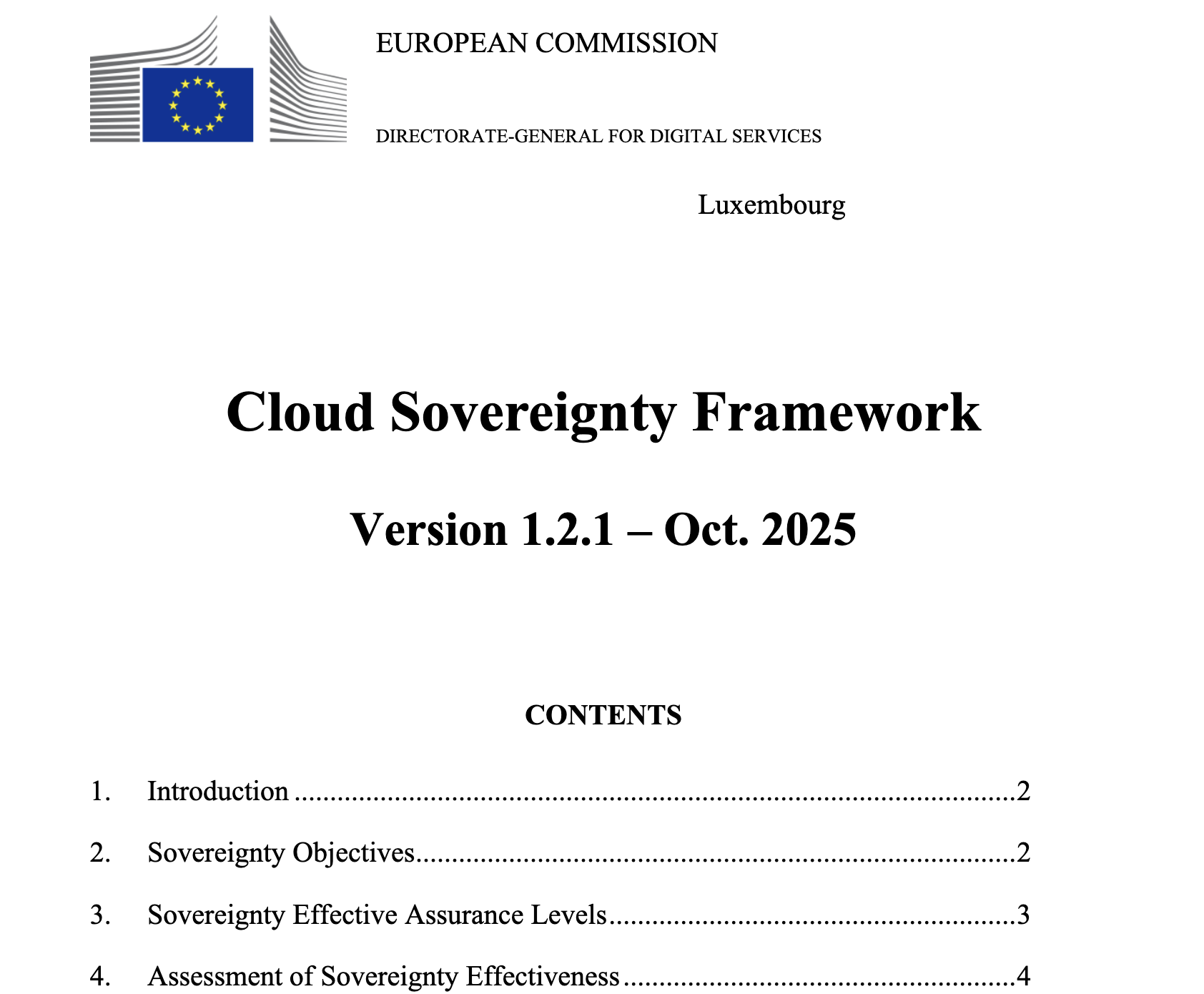
The procurement decision relied on the Commission’s Cloud Sovereignty Framework, an evaluation system designed to measure whether cloud services provide meaningful European control rather than merely European hosting.
Questions later emerged about how the framework had been applied to the selected providers. In response, the Commission released explanatory and implementation materials describing the assessment methodology in greater detail.
Those materials are significant beyond the specific procurement.
They provide cloud vendors, AI companies, public agencies, regulated businesses, and compliance teams with a preview of how European authorities may evaluate technological sovereignty in future contracts and regulatory programs.
The framework moves the discussion away from vague claims such as “EU-based,” “European cloud,” or “data hosted in Europe.” It requires evidence across multiple categories of operational and legal control.
A vendor may operate European data centers and still face sovereignty concerns if:
- Its ultimate parent company is controlled outside the EU
- Foreign law could compel access to customer information
- Core services depend on a non-EU hyperscaler
- Critical updates are controlled by a foreign software provider
- Technical support is performed outside Europe
- The provider cannot operate without a non-EU supplier
- AI models are trained or governed outside the EU
- Subcontractors can access sensitive customer environments
- The supply chain cannot be independently audited
This is a much more demanding standard than choosing an EU region from a cloud provider’s hosting menu.
The Eight Dimensions of Cloud Sovereignty
The Cloud Sovereignty Framework evaluates providers across eight broad objectives.
1. Strategic Sovereignty
Strategic sovereignty examines where the provider’s ultimate authority resides and whether important decisions can be made under European control.
This may include questions about ownership, corporate governance, voting rights, management authority, intellectual property, and the provider’s ability to maintain services if support from a parent company or critical supplier is interrupted.
A provider can have European offices and employees while strategic control remains elsewhere. The framework attempts to look beyond branding and local incorporation to determine who actually has the authority to direct the business and its technology.
2. Legal and Jurisdictional Sovereignty
Legal sovereignty addresses which governments, courts, intelligence authorities, and law enforcement bodies may exercise authority over the provider or its data.
This question is more complicated than identifying the location of a server.
A company may store information in France or Germany while remaining subject to a foreign country’s laws because of its ownership, corporate structure, personnel, or contractual relationships.
The assessment therefore considers whether non-EU legal demands could affect customer information, service availability, encryption keys, administrative access, or confidential operations.
It may also evaluate the provider’s ability to challenge foreign demands and disclose those demands to affected customers.
3. Data and AI Sovereignty
Data and AI sovereignty concerns where information is stored, processed, accessed, and used.
For traditional cloud services, that means examining data location, administrative access, encryption, key management, backups, telemetry, logs, disaster recovery, and support operations.
For AI services, the inquiry becomes broader.
Organizations may need to determine:
- Where an AI model was developed
- Where the model is hosted
- Where prompts and outputs are processed
- Whether customer information is retained
- Whether customer data is used for model training
- Who controls model updates
- Whether the model depends on a non-EU foundation model
- Whether training data originated outside the EU
- Which parties can access model telemetry
- Whether European customers can independently govern the model
An AI service cannot be considered sovereign merely because its interface is hosted in Europe. The model, training process, inference infrastructure, safety controls, and administrative authority may still depend on entities outside the EU.
4. Operational Sovereignty
Operational sovereignty examines whether the provider can maintain, support, secure, and recover its services under European control.
A vendor may claim operational independence while depending heavily on foreign support engineers, proprietary management systems, remote administrators, or software updates.
The framework therefore looks at whether the service can continue operating if access to an external supplier is restricted.
Relevant factors may include:
- Business continuity
- Disaster recovery
- Incident response
- Technical support
- Change management
- Administrative access
- Service portability
- Backup management
- Exit planning
- Continuity during supplier disruption
Operational sovereignty is ultimately a resilience question: can the provider continue serving European customers when normal global dependencies are no longer available?
5. Supply-Chain Sovereignty
Cloud and AI services are rarely delivered by a single company.
A provider may rely on infrastructure vendors, chip manufacturers, software libraries, security companies, data-center operators, telecommunications providers, model developers, consultants, and support contractors.
Supply-chain sovereignty evaluates those dependencies and the degree to which they expose customers to external control.
This category receives particularly significant weight under the Commission’s scoring methodology. That reflects a practical reality: a provider cannot credibly claim sovereignty when its essential services collapse without foreign subcontractors.
The inquiry is likely to focus on:
- Subcontractor location
- Subcontractor ownership
- Concentration risk
- Software dependencies
- Hardware dependencies
- Access to source code
- Update and patch control
- Replacement suppliers
- Contractual continuity
- Supplier audit rights
- Component traceability
For AI vendors, the dependency chain can be especially difficult to map. A company may present itself as a European AI provider while building its product on a foreign foundation model, foreign cloud infrastructure, foreign chips, and open-source components maintained outside Europe.
6. Technology Sovereignty
Technology sovereignty concerns control over the underlying systems required to deliver the service.
Authorities may evaluate whether the provider owns or controls its technical stack, can maintain it independently, and can migrate away from critical dependencies.
Open-source technology may play an important role because it can reduce reliance on proprietary vendors. However, open source does not automatically establish sovereignty. Organizations must still consider who maintains the software, where updates originate, whether internal teams understand the code, and whether the provider has the capability to operate it independently.
Portability also matters.
A service that technically stores information in Europe may still create strategic dependence if customers cannot export their data, applications, configurations, models, and logs in a usable format.
7. Security and Compliance Sovereignty
Security sovereignty examines whether the provider can protect the service using controls that are transparent, verifiable, and consistent with European requirements.
This can include cybersecurity certifications, access controls, encryption, vulnerability management, personnel screening, auditability, incident reporting, and regulatory compliance.
The framework does not treat security as separate from sovereignty. A provider cannot offer meaningful autonomy if customers cannot verify the security of the systems protecting their data.
Similarly, certifications should not become a substitute for examining control.
A provider may hold respected cybersecurity certifications while still exposing customers to foreign jurisdiction, external administrative access, or opaque subcontractor relationships.
8. Environmental Sustainability
The framework also evaluates environmental sustainability.
Although this category carries less weight than supply-chain or legal considerations, it reflects the EU’s broader policy approach to digital infrastructure.
Cloud and AI services require substantial energy, water, hardware, and data-center capacity. European authorities increasingly view those resource demands as part of responsible technology procurement.
Providers may therefore be evaluated on energy sourcing, efficiency, emissions, hardware lifecycle management, and environmental reporting.
SEAL Scores: A Threshold for Sovereignty
The Cloud Sovereignty Framework uses two related scoring mechanisms.
The first is the Sovereignty Effectiveness Assurance Level, referred to as SEAL.
SEAL is designed to indicate how strongly a provider satisfies the framework’s sovereignty and resilience expectations. The scale runs from SEAL-0 through SEAL-4.
At the lower end, a service provides little or no meaningful sovereignty. At the highest level, the service is intended to demonstrate extensive European control and an EU-based supply chain.
For the Commission’s sovereign cloud procurement, bidders reportedly needed to achieve at least SEAL-2 across every sovereignty objective.
That threshold is important.
It suggests that a provider cannot compensate for a serious weakness in one category by performing exceptionally well in another. Strong environmental reporting or operational performance, for example, may not overcome a failure to address foreign legal exposure.
This structure resembles a minimum compliance threshold more than a simple competitive ranking.
A provider must first establish an acceptable baseline across the full framework. Only after reaching that baseline does comparative scoring become useful.
The Global Sovereignty Score
The second metric is the Global Sovereignty Score.
This score allows contracting authorities to compare providers that have already reached the required SEAL threshold.
Each sovereignty objective receives a numerical score based on the provider’s answers and evidence. Those scores are then adjusted according to the weight assigned to each category.
Supply-chain sovereignty reportedly carries the greatest weight at 20%. Environmental sustainability carries 5%. The remaining objectives are weighted at 10% or 15%.
The Global Sovereignty Score is more flexible than the SEAL rating because contracting authorities can adapt parts of the methodology to fit a particular procurement.
That flexibility has benefits and risks.
It allows an agency to emphasize the sovereignty concerns most relevant to a specific service. A defense system, healthcare platform, municipal cloud service, and public website do not necessarily require identical controls.
At the same time, adjustable scoring introduces subjectivity. Vendors may meet the same baseline assurance level but receive different comparative scores depending on how an authority weights particular characteristics.
For compliance teams, the lesson is that there may not be one universal sovereignty checklist. Organizations need a core control framework that can be adapted to the sensitivity and context of each use case.
Europe Is Not Necessarily Excluding All Foreign Technology
The EU’s sovereignty strategy is sometimes described as an effort to remove American or other non-European technology from European systems.
The actual approach appears more nuanced.
One of the selected cloud providers, Proximus, uses services from S3NS, a joint venture involving France-based Thales and Google Cloud.
That relationship suggests that non-EU technology may still participate in sovereign European services when it is placed inside a sufficiently controlled legal, technical, and operational structure.
This matters because complete technological separation may be unrealistic in the short term.
European providers continue to depend on global semiconductor suppliers, open-source communities, hardware manufacturers, cloud infrastructure, software platforms, and AI models.
The emerging framework appears designed to distinguish ordinary dependence from managed dependence.
The question is not always whether foreign technology exists somewhere in the stack. The question is whether the European provider and its customers retain sufficient control over that technology, the associated data, and the continuity of the service.
That opens the door to hybrid sovereignty models.
A hybrid model may permit the use of non-European technology while requiring controls such as:
- European operational authority
- EU-based data processing
- Customer-controlled encryption
- Restricted foreign access
- Transparent subcontracting
- Independent audit rights
- European incident response
- Service continuity planning
- Technical separation
- Contractual protections
- Replacement and exit capabilities
Foreign technology may therefore remain available, but the burden of proving control will increase.
The Framework Is Already Facing Criticism
The EU’s approach has generated resistance from technology trade groups and companies concerned about market access.
One criticism is that the framework focuses too heavily on corporate location and jurisdiction without adequately distinguishing between friendly democratic allies and strategic adversaries.
Under a highly formal jurisdictional analysis, an entity domiciled inside the EU might receive more favorable treatment than a provider from a close European ally outside the Union.
Critics argue that this can create geopolitical results that do not reflect the actual security relationship between countries.
A second concern involves European startups.
Young technology companies often depend on global cloud infrastructure, international investment, foreign talent, foundation models, development tools, and cross-border partnerships. Strict sovereignty requirements could make those companies less competitive for government contracts even when their products are innovative and secure.
Larger providers may be better able to establish European subsidiaries, segregated infrastructure, local support teams, specialized compliance programs, and dedicated supply chains.
The cost of sovereignty could therefore become a barrier to entry.
A third criticism is that aggressive preference for European suppliers may invite retaliation or fragment global technology markets. Trading partners could respond with their own domestic sourcing requirements, placing European companies at a disadvantage abroad.
These objections should not be dismissed. Sovereignty has a price.
Duplicated infrastructure, restricted supplier choice, localized personnel, separate support operations, independent audits, and European-only supply chains can increase costs and reduce efficiency.
The policy dispute is ultimately about how much redundancy and independence Europe is willing to purchase in exchange for greater control.
The Cloud and AI Development Act Raises the Stakes
The Cloud Sovereignty Framework is only one part of Europe’s broader technology strategy.
The proposed Cloud and AI Development Act, commonly referred to as CADA, would create a broader EU framework for evaluating cloud and AI sovereignty.
The proposal connects sovereignty requirements to the sensitivity of the service and its use.
Rather than applying a single standard to every provider, the proposed model includes multiple assurance levels. More sensitive use cases would require stronger protections and more independent verification.
Lower-risk public-sector services may be able to use providers recognized at the first assurance level. Critical sectors and public functions could be required to use providers recognized at levels two, three, or four.
Relevant sectors may include:
- Energy
- Healthcare
- Digital infrastructure
- Critical manufacturing
- Defense
- Justice
- Law enforcement
- Border management
- Internal security
The appropriate level would depend on an impact assessment.
This risk-tiered approach is important because it aligns sovereignty controls with potential consequences.
A public-facing information website does not present the same national security, public safety, or fundamental rights risks as a defense platform, hospital system, border-control database, or law enforcement AI tool.
Independent Audits Could Become Central to Sovereignty Compliance
Under the proposed CADA structure, the first assurance level may rely on a provider’s self-assessment and EU declaration of conformity.
Higher assurance levels would require independent third-party audits.
The requirements would become progressively stricter as the assurance level increases.
At level two, providers could face conditions involving EU-established subcontractors, restrictions on using service-generated information to train AI systems outside Europe, and stronger software supply-chain protections.
Level three could impose limitations on control by non-EU entities, subject to potential Commission derogations. Personnel working on sensitive services may need EU citizenship and appropriate national security clearance.
Level four would represent the strictest sovereignty category. Sensitive data may need to remain exclusively inside the EU, high-level European cybersecurity certification may be required, and providers controlled by third-country entities may be excluded without access to a derogation.
The cumulative structure matters.
A provider seeking a higher assurance level would not merely satisfy the additional requirements for that level. It would need to meet the applicable criteria from the lower levels as well.
This could produce substantial audit obligations involving:
- Corporate ownership
- Jurisdictional exposure
- Data flows
- Subcontractor relationships
- AI training practices
- Administrative access
- Personnel qualifications
- Software provenance
- Cybersecurity controls
- Supply-chain continuity
- Technical architecture
- Incident response
- Evidence retention
Cloud and AI providers should not wait for a procurement notice or audit request before organizing this information.
How Organizations Should Prepare
Even businesses that are not bidding for EU government contracts should pay attention.
Public procurement standards often influence private vendor reviews, regulated-sector contracts, cybersecurity questionnaires, insurance underwriting, enterprise risk assessments, and industry expectations.
European customers may begin asking vendors to explain sovereignty regardless of whether a specific law requires it.
Organizations should begin with several practical steps.
Map Corporate Control
Identify the provider’s parent entities, ownership structure, voting rights, decision-makers, intellectual property ownership, and jurisdictions of incorporation.
Do not assume a European subsidiary resolves sovereignty concerns if material control remains outside the EU.
Document Data and AI Flows
Record where customer data, metadata, logs, prompts, outputs, backups, and telemetry are stored and processed.
For AI services, document whether customer information is used to train, fine-tune, evaluate, or improve models.
Inventory the Full Supply Chain
Create a reliable inventory of infrastructure providers, subprocessors, model providers, security vendors, support contractors, software dependencies, and critical hardware suppliers.
Each dependency should have an owner, risk classification, contractual record, and continuity plan.
Evaluate Foreign Legal Exposure
Determine which foreign laws could apply to the provider, its parent company, personnel, subcontractors, encryption keys, and customer information.
This analysis should involve qualified legal counsel rather than relying solely on vendor marketing materials.
Build Evidence Before the Audit
Policies and questionnaires are not sufficient by themselves.
Organizations should preserve evidence demonstrating that controls operate in practice. That may include architectural diagrams, access logs, contracts, audit reports, data-flow maps, training records, incident-response tests, resilience exercises, and supplier assessments.
Tier Services by Sensitivity
Not every cloud or AI service requires the highest sovereignty level.
Organizations should classify systems based on data sensitivity, criticality, affected individuals, public safety, national security, operational dependency, and the consequences of service interruption.
Strengthen Vendor Contracts
Contracts should address data location, subprocessors, foreign access, model training, security controls, audit rights, incident reporting, continuity, portability, termination, and deletion.
Sovereignty promises should be converted into enforceable obligations.
Digital Sovereignty Is Becoming Part of AI Governance
The most important shift is that digital sovereignty can no longer be treated solely as a cloud infrastructure issue.
AI systems introduce new layers of dependence.
A company may control its application and data while having limited authority over the foundation model that produces the output. Model updates may alter system behavior without the customer’s approval. Prompts may be processed in undisclosed locations. Safety controls may be managed by a foreign provider. Training data may be impossible to inspect.
An effective AI governance program must therefore examine both the use case and the technology supply chain behind it.
That requires an inventory capable of connecting:
- AI systems
- Models
- Providers
- Data sources
- Hosting environments
- Subprocessors
- Business owners
- Risk assessments
- Applicable laws
- Required controls
- Audit evidence
- Material changes
Sovereignty cannot be evaluated through a one-time vendor questionnaire that disappears into a shared folder.
It must become part of continuous AI and third-party risk management.
How Captain Compliance Supports Audit-Ready Governance
Captain Compliance helps organizations structure privacy, AI governance, vendor risk, and compliance evidence in a more defensible operating system.
As sovereignty requirements become more detailed, organizations will need to move beyond informal representations that a provider is “EU hosted” or “GDPR compliant.”
They will need documented assessments showing who controls the service, where information moves, which suppliers are involved, what risks were identified, which controls were applied, and what evidence supports the conclusion.
That is the difference between a marketing claim and an audit-ready compliance position.
The EU’s sovereignty frameworks are still evolving. Their long-term implementation will depend on legislative negotiations, technical standards, procurement decisions, market capacity, and the ability of providers to absorb the cost of compliance.
But the direction is already clear.
Europe is converting digital sovereignty from a broad policy objective into a measurable system of assurance.
Cloud and AI vendors will increasingly be judged not only by what their technology can do, but also by who controls it, which laws reach it, what dependencies sustain it, and whether customers can continue operating when those dependencies fail.
The companies that prepare early will be better positioned to answer those questions with evidence rather than assurances.
Frequently Asked Questions
What is digital sovereignty?
Digital sovereignty is the ability of an organization, government, or region to retain meaningful control over its data, technology, infrastructure, operations, and strategic decisions without excessive dependence on outside jurisdictions or suppliers.
What is the EU Cloud Sovereignty Framework?
The Cloud Sovereignty Framework is a European Commission assessment methodology for evaluating cloud providers across strategic, jurisdictional, data, AI, operational, supply-chain, technological, security, compliance, and sustainability considerations.
What does SEAL mean?
SEAL stands for Sovereignty Effectiveness Assurance Level. It is a tiered rating intended to measure the level of sovereignty and resilience offered by a cloud service.
Is storing data in Europe enough to establish digital sovereignty?
No. Data residency is only one factor. Authorities may also examine ownership, foreign legal exposure, administrative access, subcontractors, software dependencies, AI model control, encryption, support operations, and business continuity.
Can a non-European technology provider meet EU sovereignty requirements?
Potentially. The emerging EU approach appears capable of recognizing hybrid models where non-European technology is operated within sufficiently strong European legal, technical, and operational controls.
Will cloud and AI sovereignty require independent audits?
Under the proposed Cloud and AI Development Act, higher assurance levels would require independent third-party audits. Lower assurance levels may permit provider self-assessment and a declaration of conformity.
Why does digital sovereignty matter for AI systems?
AI systems can depend on foreign foundation models, training data, cloud infrastructure, support teams, safety controls, and model updates. Those dependencies can reduce an organization’s ability to govern the system and protect its data.
What should cloud and AI providers do now?
Providers should map ownership, jurisdictional exposure, data flows, model dependencies, subprocessors, software supply chains, personnel access, resilience controls, and supporting evidence. They should also prepare for more detailed customer questionnaires and independent audits.
Put this into practice
Turn privacy guidance into working controls.
Captain Compliance helps teams discover tracking technologies, enforce consent, manage privacy requests and document the evidence behind every decision.