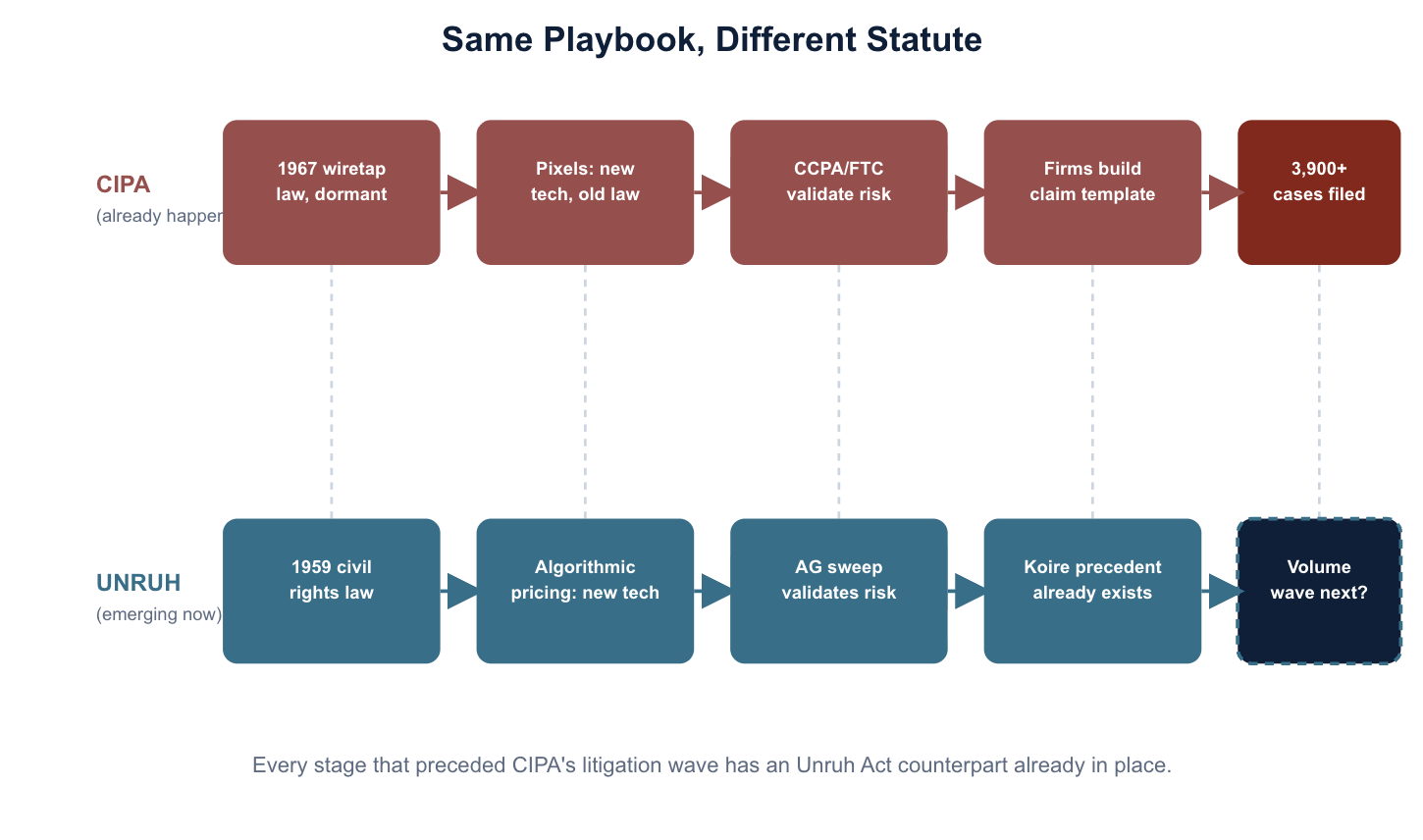
In 1967, California lawmakers passed a wiretapping statute aimed at phone taps and recorded conversations. Nobody in that legislature imagined it would one day become the basis for more than 3,900 lawsuits over website tracking pixels. But that’s exactly what happened to the California Invasion of Privacy Act (CIPA) — and the mechanics behind that transformation are now lining up almost identically around a different, older California statute: the Unruh Civil Rights Act.
Unruh Act Meets CCPA: The Coming Wave of Algorithmic Discrimination Lawsuits
This isn’t a prediction pulled from nowhere. California’s Attorney General has already opened a formal sweep into “surveillance pricing” under the CCPA. Plaintiffs’ firms have already spent a decade building Unruh Act litigation infrastructure around website accessibility. Legislators in California and New York have already put algorithmic pricing discrimination into statutory language. The pieces are on the board. This piece walks through what the Unruh Act actually says, how the CIPA wave got started, why the exact same playbook is assembling around Unruh right now, and what businesses should be doing before the first wave of demand letters lands.
At a glance
- The Unruh Civil Rights Act (California Civil Code Section 51) bars discrimination by California businesses based on protected characteristics including race, sex, disability, national origin, age, and sexual orientation, with statutory damages of at least $4,000 per violation.
- Its dominant digital use case for the past decade has been website accessibility litigation (WCAG/screen-reader claims) — but that’s not where the growth is headed next.
- California’s AG opened an investigative sweep in January 2026 into “surveillance pricing” — using personal data to set individualized prices — as a potential CCPA violation.
- Unruh Act precedent (Koire v. Metro Car Wash, 1985) already establishes that charging different prices based on a protected characteristic is a per se violation — and modern algorithmic pricing can reconstruct those same characteristics from browsing, location, and device data without ever asking for them directly.
- That overlap — a data privacy violation theory (CCPA) stacked on top of a decades-old civil rights statute (Unruh) — is structurally identical to how CIPA got repurposed for pixel litigation.
- Proposed California legislation (AB 2564) would go further still, with civil penalties up to $12,500 per violation for surveillance pricing outright.
What the Unruh Act actually says
Enacted in 1959, the Unruh Civil Rights Act guarantees “full and equal accommodations, advantages, facilities, privileges, or services in all business establishments of every kind whatsoever” to all Californians, regardless of sex, race, color, religion, ancestry, national origin, age, disability, medical condition, genetic information, marital status, sexual orientation, citizenship, primary language, or immigration status. Since 1992, any violation of the federal Americans with Disabilities Act (ADA) automatically counts as an Unruh Act violation too, which is why the two statutes are almost always cited together. Two features make it a uniquely attractive statute for the plaintiffs’ bar — the same two features that made CIPA attractive before it:- Statutory damages with no proof of actual harm required. A successful claim carries a minimum of $4,000 per violation (or up to three times actual damages, if greater), plus attorney’s fees — regardless of whether the plaintiff can show they lost any money or suffered measurable harm.
- A demand-letter economy built for volume. Because filing fees and litigation costs are real but the statutory floor is guaranteed, plaintiffs’ firms have built entire practices around sending pre-litigation demand letters at scale, settling the large majority before a complaint is ever filed.
Where Unruh has lived for the past decade: website accessibility
Until now, the Unruh Act’s digital footprint has been almost entirely about accessibility. Plaintiffs — frequently blind or visually impaired individuals represented by a small number of high-volume firms — allege that a website or app isn’t compatible with screen readers or keyboard navigation, citing the Web Content Accessibility Guidelines (WCAG) 2.1 Level AA as the de facto standard even though WCAG itself isn’t legally binding. Los Angeles County alone has seen periods with roughly a dozen such filings a day. Courts have narrowed this somewhat — California’s Court of Appeal held in Martinez v. Cot’n Wash that a purely online retailer without a physical location isn’t automatically covered, and that plaintiffs must show intentional discrimination rather than just an unaddressed demand letter. But that narrowing applies specifically to the accessibility fact pattern. It says nothing about a very different theory that’s now taking shape: discrimination through data use rather than through an inaccessible interface.The CIPA playbook, and why it’s about to repeat
CIPA’s transformation from a 1960s wiretap statute into the most active privacy litigation vehicle in the country followed a specific sequence. It’s worth naming each step, because Unruh is now positioned to follow the identical path:- An old statute with strict, favorable damages sat mostly dormant for decades outside its original context.
- New technology created a fact pattern the statute’s authors never anticipated — in CIPA’s case, tracking pixels that transmit visitor data to third parties in real time, arguably resembling an “interception.”
- Regulators separately validated the underlying conduct as a privacy problem — CCPA enforcement and FTC actions against pixel misuse gave plaintiffs’ firms a regulatory backdrop to point to.
- Plaintiffs’ firms formalized a repeatable claim template — demand letter, proposed complaint, quick settlement math — and scaled it across thousands of websites.
- Volume created its own momentum, with more than 3,900 CIPA cases filed in California by mid-2026 and copycat theories spreading to other states’ wiretap statutes.
- An old statute with strict, favorable damages: Unruh’s $4,000-per-violation floor, no-actual-harm requirement, and mandatory fee-shifting are, if anything, more plaintiff-friendly than CIPA’s framework.
- A new fact pattern the statute’s authors never anticipated: algorithmic and “surveillance” pricing, where a business uses browsing history, location, device type, purchase timing, and other behavioral data to set an individualized price — data that can function as a proxy for age, national origin, disability status, or other protected characteristics without the business ever asking for that information directly.
- Regulators validating the underlying conduct as a privacy problem: California’s Attorney General opened a formal investigative sweep into surveillance pricing in January 2026, explicitly framing it as a potential CCPA violation tied to the statute’s “purpose limitation” principle. New York has already enacted a disclosure law requiring the exact phrase “THIS PRICE WAS SET BY AN ALGORITHM USING YOUR PERSONAL DATA” next to algorithmically set prices, and its law separately bars using protected-class data to set prices.
- The claim template already exists. Unruh doesn’t even need a novel legal theory here — Koire v. Metro Car Wash established back in 1985 that charging different prices to different people based on a protected characteristic (that case involved gender-based pricing at car washes) is a straightforward Unruh violation. Plaintiffs’ firms don’t have to invent a new interpretation; they just have to show that an algorithm’s output functions the same way a posted sign once did.
- The infrastructure to scale it already exists, sitting inside the same firms that spent the last decade building Unruh accessibility practices and the last three years building CIPA pixel practices.
Beyond pricing: other data-driven fronts opening under Unruh
Surveillance pricing is the clearest near-term vector, but it’s not the only one. A few adjacent practices sit on the same structural fault line — a business process that runs on personal data and produces a differential outcome tied, even indirectly, to a protected characteristic:- Automated decision-making technology (ADMT). California’s Civil Rights Council finalized regulations effective October 2025 extending the state’s Fair Employment and Housing Act to AI-driven employment tools, explicitly opening the door to algorithmic discrimination claims. The same reasoning — an automated system producing a disparate outcome across a protected class — maps directly onto Unruh’s “full and equal” standard for consumer-facing decisioning, not just employment.
- Biometric and identity-verification gates. Age- and identity-verification tools that perform unevenly across skin tones, accents, or disabilities can plausibly deny “full and equal” access to a service for reasons tied to a protected characteristic — a theory that sits squarely inside Unruh’s existing accessibility caselaw, just applied to a newer technology.
- Consent and preference interfaces that aren’t accessible. A cookie banner or preference center that a screen reader can’t navigate blocks disabled users from exercising privacy rights that sighted users can exercise freely — a genuinely novel overlap between classic Unruh accessibility theory and modern privacy compliance UX.
Why this matters more in California than anywhere else
Every ingredient for a repeat of the CIPA pattern is concentrated in California specifically:- The Unruh Act itself, with damages that don’t require proof of harm.
- A CCPA regulator (the CPPA) already treating data-driven pricing and ADMT as active enforcement priorities.
- An Attorney General who has publicly named surveillance pricing as a privacy issue.
- Proposed state legislation (AB 2564) that would independently prohibit surveillance pricing with civil penalties up to $12,500 per violation — three times CIPA’s statutory ceiling.
- An established, well-capitalized plaintiffs’ bar that has already built two prior waves of litigation infrastructure (ADA/Unruh accessibility, then CIPA pixel claims) and is actively looking for the next fact pattern.
How businesses should prepare
- Audit any personalization or dynamic pricing system for inputs that could function as a proxy for a protected characteristic — location data that correlates with national origin or income, device type that correlates with age, browsing patterns that correlate with disability-related searches.
- Document the purpose-limitation basis for any use of personal data in pricing, and be prepared to show that pricing logic doesn’t rely on, or correlate with, protected-class signals.
- Extend accessibility testing beyond your core site to cookie banners, preference centers, and consent interfaces specifically — the overlap between accessibility and privacy UX is a foreseeable next claim pattern, not a hypothetical one.
- Review any ADMT or algorithmic decisioning tool that affects consumer-facing outcomes (approval, pricing, eligibility, verification) for disparate impact across protected classes, not just for accuracy or performance.
- Treat this as a converged risk, not two separate ones. Just as recent complaints routinely plead CIPA alongside CCPA and the federal Wiretap Act in a single filing, expect future complaints to plead Unruh alongside CCPA in a single filing — meaning your privacy team and any civil-rights/employment counsel need to be coordinating now, not after a demand letter arrives.
- Get ahead of disclosure even where not yet mandated in your jurisdiction — New York’s model of plainly disclosing algorithmically set prices is a preview of what plaintiffs’ firms will treat as the “reasonable expectation” baseline everywhere else.