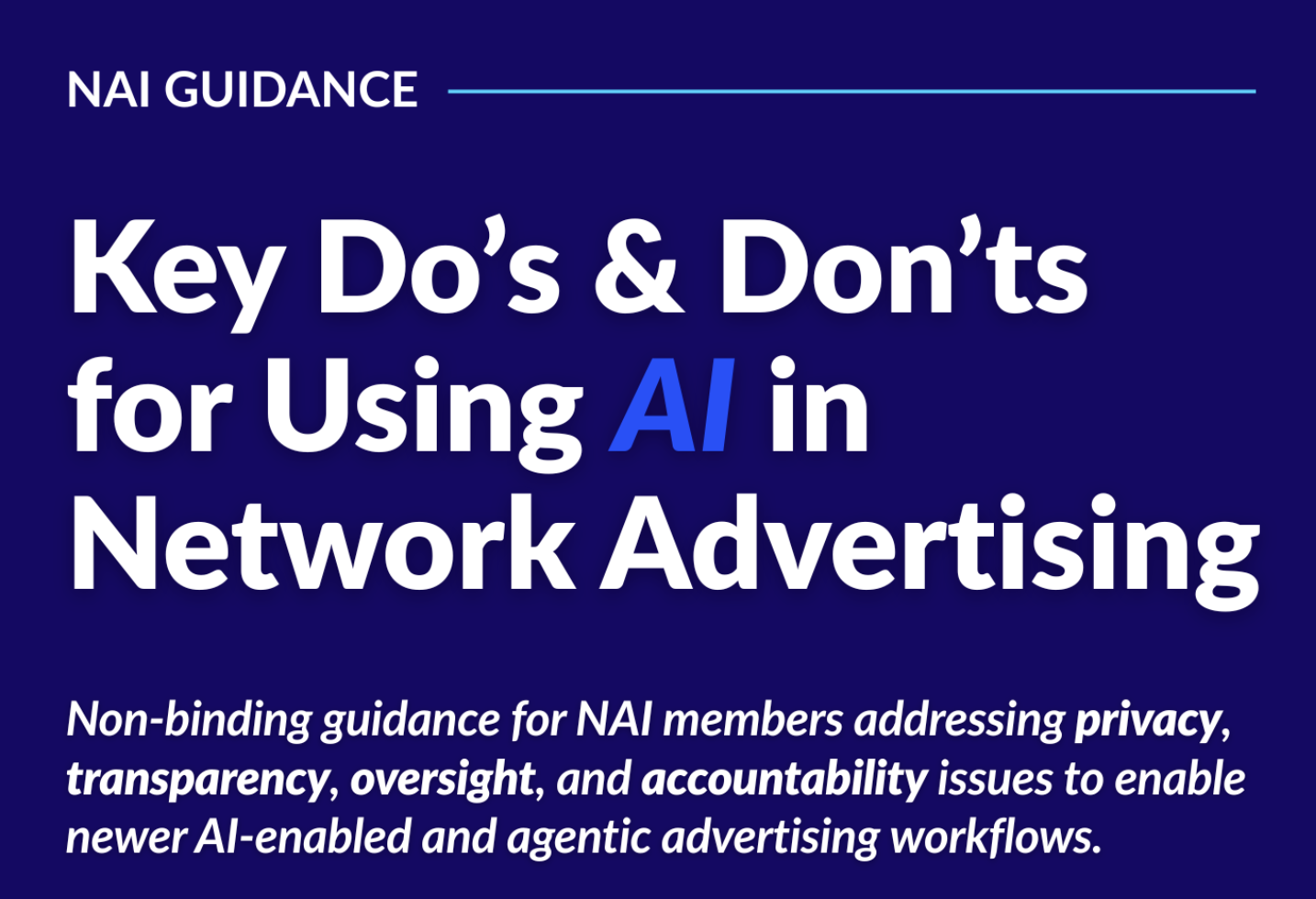
The Network Advertising Initiative (NAI) has released timely new guidance titled Key Do’s & Don’ts for Using AI in Network Advertising. Published on July 20, 2026, the document helps ad-tech companies navigate the rapid evolution of generative AI and increasingly autonomous “agentic” systems while maintaining strong privacy and data governance practices.
This voluntary guidance builds on the NAI’s existing Self-Regulatory Framework and addresses a critical gap: how privacy expectations should scale as AI tools gain more independent decision-making power in digital advertising workflows.
Why This Guidance Matters Now
AI is not new to advertising. Machine learning and predictive modeling have been used for years. What has changed is the emergence of generative capabilities and agentic systems that can act with greater autonomy — turning natural-language prompts into audience segments, bidding on inventory, or executing campaigns with minimal human oversight.
These advancements create new privacy considerations. The NAI guidance provides practical, plain-English recommendations to help companies adopt AI responsibly without waiting for formal regulation or technical standards to fully catch up.
Core Topics Covered in the NAI Guidance
The document organizes recommendations around nine key areas, each with specific do’s, don’ts, and working questions:
- Inventory and Enabling of AI Use Cases — Know which tools are AI-enabled and who owns them.
- Advertising Audience/Segment Review and Activation — Review AI-generated segments for potential sensitive inferences (e.g., health proxies).
- Testing and Monitoring of AI Systems — Implement ongoing testing to catch unintended outcomes.
- Disclosures About How AI Systems Are Used — Be transparent with consumers and partners about AI involvement.
- Permissions and Constraints Applied to AI Systems — Set clear boundaries on what AI can access or do.
- Choice and Signal Handling — Ensure consumer opt-outs and signals (like Global Privacy Control) are respected even by autonomous systems.
- Oversight and Logging for Agentic AI Systems — Maintain human oversight and audit trails for systems that act independently.
- Contracting and Risk Allocation Between AI Users and AI Vendors — Clarify responsibilities in vendor agreements.
- Accountability — Ensure humans remain ultimately responsible for outcomes.
The guidance also includes a practical one-page checklist with working questions companies can use immediately.
Proportionality: Scale Controls to Risk
A key principle throughout the document is proportionality. Not every AI tool requires the same level of oversight. An advisory system that surfaces recommendations for human review needs lighter controls than a fully agentic system that can bid, segment, and execute campaigns autonomously. The more authority and potential impact an AI system has, the stronger the requirements for testing, monitoring, permissions, and human intervention should be.
Industry Context and Stakeholder Reactions
The NAI’s guidance comes at a pivotal moment. Ad-tech companies are actively experimenting with generative and agentic AI to improve targeting, creative generation, and campaign efficiency. At the same time, regulators and privacy advocates are watching closely for risks around transparency, consent, sensitive inferences, and accountability.
This voluntary framework helps the industry demonstrate proactive governance while technical standards and potential regulation continue to evolve. It reinforces that privacy and data governance must keep pace with technological capability — especially when systems can act independently.
Practical Compliance Implications for Businesses
For companies using or considering AI in advertising workflows, the NAI guidance offers a valuable self-assessment tool. Recommended action items include:
- Inventory AI Tools — Create and maintain a clear inventory of all AI-enabled systems, including who owns each use case.
- Review Audience Segments — Test AI-generated segments for unintended sensitive inferences (health, beliefs, etc.).
- Strengthen Testing & Monitoring — Implement regular testing protocols and ongoing monitoring, especially for agentic systems.
- Update Disclosures — Ensure privacy notices and partner communications clearly describe AI use where material.
- Respect Consumer Choices — Verify that opt-outs and universal signals are honored end-to-end, even when AI systems act autonomously.
- Strengthen Contracts — Review agreements with AI vendors to clarify risk allocation, oversight, and compliance responsibilities.
- Maintain Human Accountability — Establish clear escalation paths and logging for high-autonomy systems.
Businesses already subject to CCPA/CPRA, GDPR, or other comprehensive privacy laws will find many of these recommendations align with existing obligations around transparency, accountability, and data protection assessments.
How This Fits Into the Broader AI & Privacy Landscape
The NAI guidance is part of a larger trend. Industry self-regulatory bodies, alongside regulators, are developing practical frameworks for responsible AI use in advertising and beyond. It complements broader developments in AI governance, data minimization, and consumer rights in the digital advertising ecosystem.
For companies operating across multiple jurisdictions, aligning with NAI recommendations can help reduce compliance friction and demonstrate good-faith efforts even as formal rules continue to develop.
FAQs: NAI AI Guidance for Digital Advertising
Q: Is the NAI guidance mandatory?
A: No. It is voluntary best-practice guidance for NAI members and the broader ad-tech community. However, following it can help demonstrate accountability and reduce risk.
Q: What is “agentic” AI in this context?
A: Systems that can act with greater autonomy — for example, bidding on inventory, building segments, or executing campaign elements with less real-time human intervention.
Q: How does this relate to existing privacy laws?
A: The guidance builds on the NAI Self-Regulatory Framework and aligns with principles in laws like the CCPA/CPRA, GDPR, and state privacy statutes around transparency, consent, and accountability.
Q: Should non-NAI members follow this guidance?
A: Yes. The principles are broadly applicable to any company using AI in digital advertising and can serve as a helpful self-assessment tool.
Conclusion: Proactive Governance for AI in Advertising
The NAI’s new guidance provides timely, practical direction for an industry navigating rapid AI advancement. By focusing on inventory, testing, disclosures, consumer choice, and human accountability — scaled proportionally to system autonomy — it helps companies adopt powerful new tools responsibly.
As generative and agentic AI capabilities continue to expand, privacy and data governance must evolve in parallel. Organizations that treat this guidance as a starting point for self-assessment and process improvement will be better positioned to manage risk and maintain consumer trust.
At Captain Compliance, we help businesses integrate responsible AI practices into their privacy and advertising programs. From AI use-case inventories and risk assessments to updated privacy notices, vendor contracts, and governance frameworks, our team provides practical support tailored to the evolving digital advertising landscape.
Using AI in your advertising or audience workflows? Contact Captain Compliance today for a confidential review of your current practices against the NAI guidance and other emerging standards.
Stay informed on AI governance, digital advertising privacy, and compliance best practices with Captain Compliance.