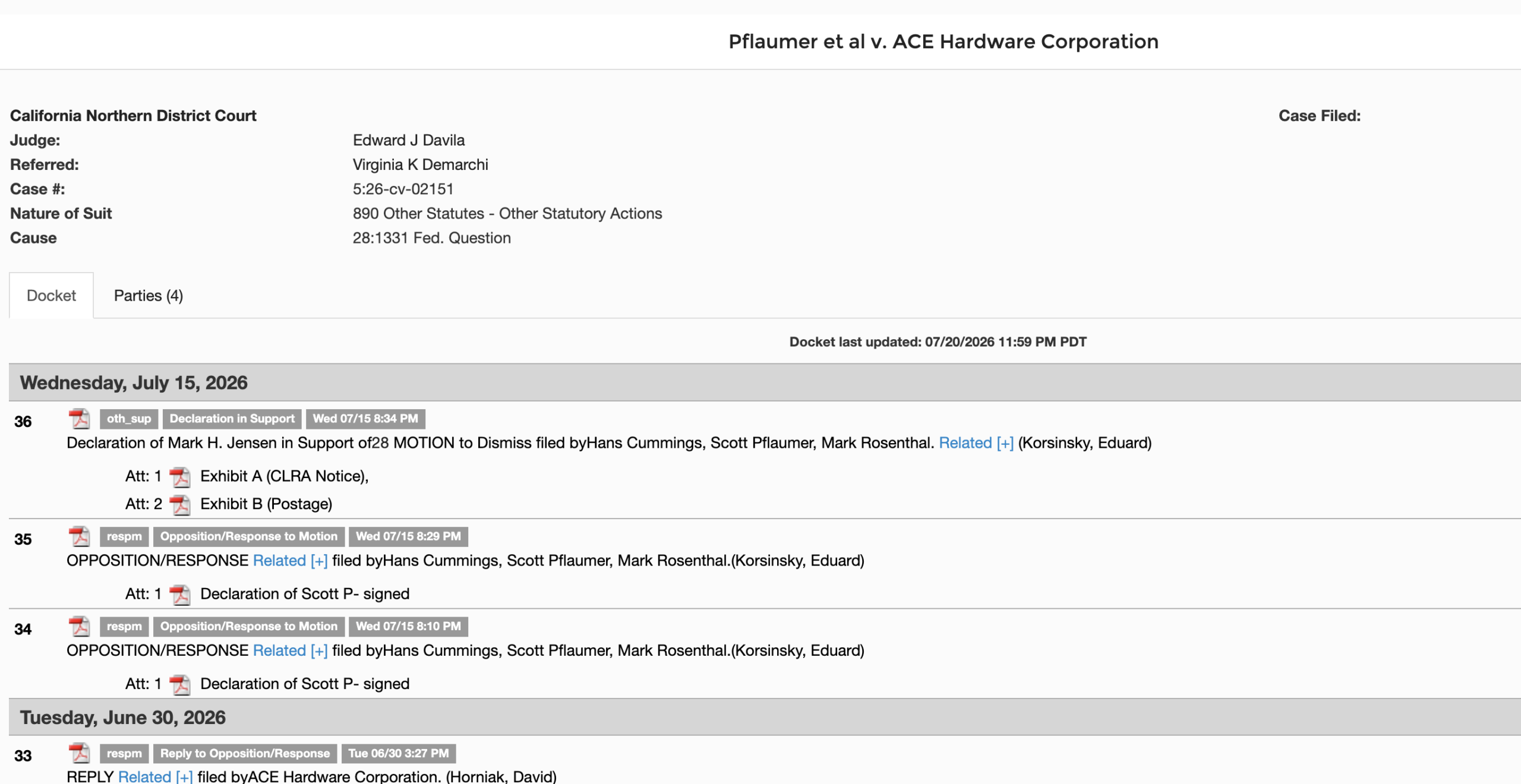
We have screamed at the top of our virtual lungs about the risks of having a broken cookie banner and having to deal with a wrongful collection claim. Now we are seeing ads being run on social media from plaintiffs firms recruiting potential plaintiffs for privacy lawsuits and the rise of even a few pro-se plaintiffs who are coming up with a series of unique privacy claims and targeting unsuspecting business owners. One of these cases is with national hardware retailer Ace.
Compliance teams that believe a cookie consent or opt-out banner is enough to neutralize California privacy risk are learning a hard lesson. A growing wave of lawsuits under the California Invasion of Privacy Act (CIPA) is targeting a technical flaw known as the “broken banner” — and pairing it with claims under the Unfair Competition Law (UCL) and Consumers Legal Remedies Act (CLRA) that can dramatically increase potential damages.
The case of Pflaumer v. Ace Hardware illustrates how plaintiffs are turning ordinary website order-of-operations issues into multi-pronged litigation that goes far beyond traditional CIPA statutory damages of $5,000 per violation.
How CIPA Claims Have Evolved
Early CIPA website litigation focused primarily on the interception of communications under Penal Code § 631(a) or the use of pen-register-like tracking under § 638.51. Damages were largely statutory. Plaintiffs now routinely layer additional causes of action that change the risk profile entirely.
By attaching a UCL claim (Business & Professions Code § 17200), plaintiffs seek restitution of advertising technology revenues allegedly generated from the improper use of user data. This moves the exposure from fixed statutory amounts into the realm of actual profits attributable to AdTech activity. When the website has a commercial component (e-commerce, subscriptions, or paid services), CLRA claims add actual damages, punitive damages, and attorney fees.
Common-law fraud or deceit theories further open the door to punitive damages under California Civil Code provisions requiring clear and convincing evidence of malice, oppression, or fraud — particularly if internal documents show the defendant knew the banner was non-functional and continued operating it.
The Core Technical Problem: Order of Operations
The typical modern website loads in layers. The consent or opt-out banner is often rendered last so it appears on top of the page. In many implementations, third-party advertising and analytics scripts (AdTech) are embedded earlier in the page load or execute asynchronously. The result: tracking pixels, tags, and data transmissions fire before the user ever sees the banner or makes a choice.
When this happens, the website has effectively promised users control over their data while simultaneously transmitting that data regardless of the eventual selection. Plaintiffs characterize the non-functional opt-out as a deceptive business practice. The banner becomes both the promise of privacy and the evidence of the breach.
This is precisely the theory advanced in Pflaumer v. Ace Hardware. Plaintiffs allege that AdTech scripts executed and shared user data with third-party advertising partners before the consent banner was presented. By the time a user could opt out, the data had already left the site.
The Three Prongs of a UCL Claim in These Cases
- Unlawful: The underlying CIPA violation serves as the predicate unlawful act.
- Fraudulent: The banner represented that opt-out functionality existed and would be honored when, in practice, it did not.
- Unfair: Data was collected and monetized in a manner inconsistent with the website’s own privacy disclosures.
When the site involves consumer transactions, the same facts support a CLRA claim based on a deceptive representation made in connection with the sale or lease of goods or services.
Why This Risk Is Spreading
Broken-banner allegations are becoming standard pleading language rather than novel theories. Many organizations rushed to implement consent management platforms (CMPs) after earlier waves of CIPA and CCPA litigation without validating that the technical sequence of events actually honored user choices. The result is a new category of exposure that turns a compliance control into a liability generator.
Internal communications about CMP deficiencies, ticket logs documenting banner failures, and change-management records that show scripts were added without re-testing consent behavior are now high-value discovery targets.
How to Detect and Fix the Problem
A working banner is not enough and you absolutely need to work with a company like Captain Compliance who can handle the integrations and set you up with a banner that won’t create regulatory and legal issues. Organizations must verify that AdTech does not execute until after affirmative consent (or that it is suppressed when a user opts out).
Recommended testing approach:
- Use browser developer tools or a traffic-capture proxy to record all network requests from a clean test session.
- Load the page and immediately examine the capture for third-party AdTech domains, pixels, or data transmissions that occur before the banner is interactive.
- Interact with the banner (accept all, reject all, or granular choices) and compare the resulting traffic.
- Confirm that opt-out selections prevent subsequent AdTech execution or data sharing.
- Repeat testing after any website change, tag-manager update, or new vendor integration.
Properly functioning systems show bidirectional communication with the first-party domain only until consent is granted. After consent, AdTech appears. After opt-out, it does not.
Working with a vendor who offers a litigation guarantee and works with you to ensure that the CMP is setup properly while also offering continuous monitoring is really important. Third-party CMP vendors can cause risk and one attorney recently posted on Linkedin that once their clients sites got too much traffic that their banners started to freeze and screw up their website. This was one of many complaints of low quality cookie banners that can cause issues with your website and the idea of a cheap banner ends up costing you more money when you get a lawsuit or regulatory fine.
You can also use the radar scanning tool from Captain Compliance for automated testing tools can assist with cookie audits and governance and there are other 3rd party tools in the marketplace but they are not a substitute for independent traffic analysis. The order-of-operations issue is often invisible to the CMP itself if scripts are loaded outside its control.
Privacy Compliance Recommendations
- Treat consent functionality as a critical path item in every change-management process.
- Document test results and retain captures as evidence of ongoing compliance efforts.
- Segment AdTech loading so that non-essential tags are blocked until consent is recorded.
- Review privacy policies and banner language for consistency with actual technical behavior.
- Evaluate insurance coverage and contractual indemnification language with AdTech vendors in light of expanded damages theories.
FAQs: Broken Consent Banners and Expanded CIPA Risk
Q: Is a standard consent management platform enough protection?
A: Not by itself. Many CMPs correctly display a banner but cannot control scripts loaded earlier in the page or via tag managers. Independent traffic testing is required.
Q: How much can damages increase under UCL or CLRA theories?
A: UCL restitution claims can reach revenues attributable to the improper use of data in the AdTech ecosystem. CLRA adds actual damages, punitive damages, and attorney fees, significantly raising the stakes beyond CIPA’s $5,000 statutory amount.
Q: Does this risk apply only to California residents?
A: Primary exposure is under California statutes, but websites accessible to California users can face claims. Multi-state operations should evaluate whether similar theories could be asserted under other consumer-protection laws.
Q: What is the fastest way to reduce immediate risk?
A: Conduct a traffic-capture audit of key pages, suppress pre-consent AdTech execution where possible, and document remediation steps.
Compliance Requires Verification, Not Just Implementation
The Pflaumer v. Ace Hardware litigation and similar cases demonstrate that installing a consent banner without validating its real-world behavior creates new and larger liability. Plaintiffs are successfully combining CIPA with UCL, CLRA, and common-law theories to expand both the scope of claims and the potential damage awards.
Organizations that treat consent management as a one-time implementation rather than an ongoing technical and compliance control are exposed. Regular testing, proper sequencing of scripts, and documented verification are now essential components of a defensible privacy program.
At Captain Compliance, we help companies audit consent mechanisms, map AdTech data flows, remediate order-of-operations issues, and build sustainable testing processes. Whether you are responding to a demand letter or proactively reducing risk, our team provides the technical and regulatory expertise needed to close these gaps.
Concerned your consent banners may be creating liability rather than protecting against it?
Get a free privacy audit from our team of IAPP experts for a confidential technical and legal review of your website’s consent implementation.
Stay ahead of evolving CIPA, CCPA, and related privacy litigation trends with practical guidance.
Book a demo below to learn more.