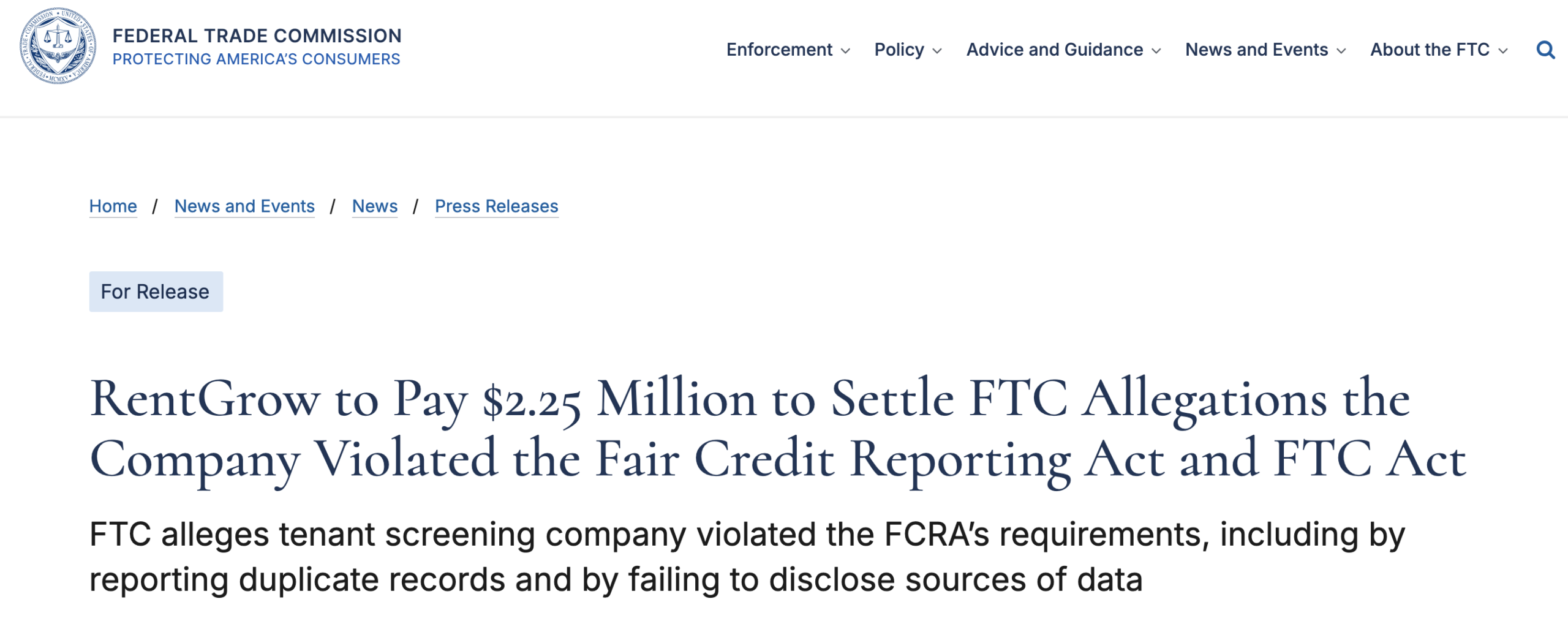
The FTC just delivered another reminder that data accuracy isn’t a nice-to-have — it’s a legal obligation with a price tag. On July 9, 2026, the agency announced that RentGrow Inc., a Massachusetts-based tenant screening company, will pay a $2.25 million penalty to settle allegations that it violated the Fair Credit Reporting Act and the FTC Act. The complaint, filed by the Department of Justice on the FTC’s referral in the U.S. District Court for the District of Columbia, paints a picture of a screening operation that knew its reports were flawed and didn’t fix them until regulators came knocking.
For any company that compiles data about consumers and sells it to decision-makers — landlords, employers, lenders — this case is worth reading closely. Here’s what went wrong and what it signals.
Why a Tenant Screening Company Is a Consumer Reporting Agency
RentGrow compiles information from multiple sources into background screening reports and sells them to landlords and property managers, who use them to decide who gets an apartment. Under the FCRA, that makes RentGrow a consumer reporting agency, with everything that status entails: a duty to maintain reasonable procedures assuring the maximum possible accuracy of its reports, a duty to disclose the sources behind a report when a consumer asks, and a duty to follow specific procedures when a consumer disputes what a report says.
Plenty of data companies still think of “CRA” as a label reserved for the big three credit bureaus. Regulators don’t. If you assemble consumer data and sell it for eligibility decisions — housing, employment, credit, insurance — the FCRA almost certainly applies to you, whether or not the word “credit” appears anywhere in your product.
The Duplicate Records Problem
The heart of the FTC’s accuracy allegations is almost mundane, which is what makes it alarming. RentGrow’s reports allegedly included duplicate case records — the same criminal proceeding or eviction action appearing multiple times — making applicants look like they had more convictions or more eviction suits than they actually did. According to the complaint, this happened even when RentGrow’s data vendor supplied the information correctly; the duplication was introduced by how RentGrow itself displayed the data.
Worse, the FTC alleged the company was aware of the problem and didn’t implement reasonable procedures to address it until the investigation began. Consider what a phantom second eviction means in a competitive rental market: a denied application, a lost home, and the applicant likely never knowing why. That human stakes framing came straight from the FTC’s Bureau of Consumer Protection Director, Christopher Mufarrige, who noted that inaccurate background reports affect people’s ability to obtain housing or a job — and that companies producing them have a legal responsibility to get them right.
Hidden Sources and Dead-End Disputes
The accuracy failures were compounded by transparency failures. When consumers requested the information and sources behind their reports, RentGrow allegedly withheld the fact that it used LexisNexis Accurint to pull historical addresses and middle names — data it then used to match criminal and eviction records to applicants. If you don’t know a source exists, you can’t challenge what it feeds into your file. Matching logic built on undisclosed data is exactly how the wrong person’s record ends up on your report.
And when consumers did dispute their reports, the complaint alleges RentGrow sometimes labeled disputes “invalid” and simply stopped — something the FCRA does not permit. The FTC Act count adds a final insult: in some cases where consumers won their disputes and information was corrected or deleted, RentGrow allegedly told the consumer it had notified the property manager of the outcome, while telling the property manager there was no change. The correction existed on paper and nowhere else.
The Order’s Terms
Beyond the $2.25 million penalty, the proposed order requires RentGrow to maintain reasonable accuracy procedures — specifically including procedures to prevent duplicate records for the same criminal or eviction proceeding — to comply with the FCRA’s other requirements, and to stop misrepresenting whether it provides updated reports to landlords after successful disputes. The Commission vote to refer the complaint and approve the order was 2-0.
What Compliance Teams Should Take From This
Three lessons stand out. First, accuracy obligations attach to your output, not just your inputs. RentGrow’s vendor data was reportedly fine; the display layer created the violations. Auditing your sources isn’t enough if your own processing introduces errors. Second, “we knew and didn’t fix it” is the aggravating factor regulators look for. Known data-quality issues sitting in a backlog are enforcement exhibits waiting to be filed. Third, dispute handling is a compliance function, not a customer service afterthought. Every step — intake, investigation, resolution, and notification to the parties relying on the report — is legally mandated, and misrepresenting any of those steps converts an FCRA problem into an FTC Act deception problem.
The FCRA is one of the oldest privacy statutes in the country, and it remains one of the most actively enforced. If your business touches consumer data that feeds decisions about housing, employment, or credit, your exposure doesn’t depend on whether you call yourself a consumer reporting agency. It depends on what you actually do with the data.
Not sure whether your data practices trigger FCRA obligations, or whether your accuracy and dispute procedures would hold up under an FTC microscope? Contact Captain Compliance today for a free compliance assessment.