The commercial internet is facing a structural crisis rooted not in cybersecurity or technology, but in the abuse of a statutory loophole. Over the past few years, a highly coordinated, industrial-scale litigation engine has targeted businesses across California and the United States.
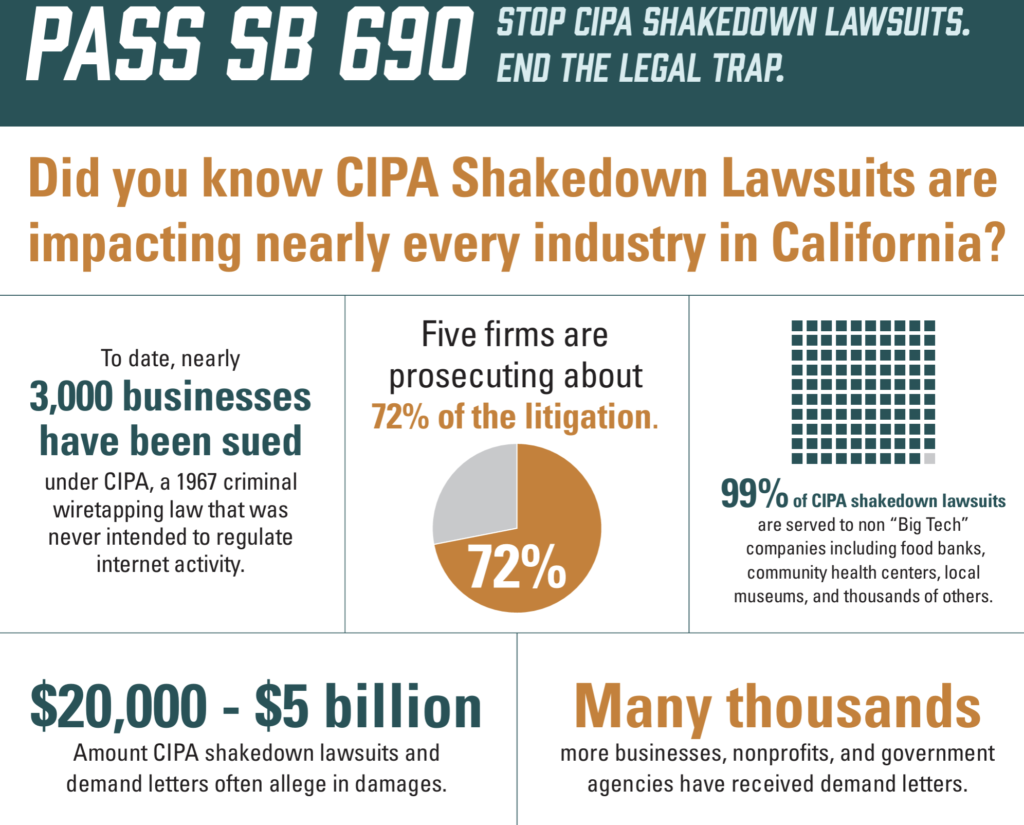
The weapon of choice is the California Invasion of Privacy Act (CIPA), an archaic criminal statute passed in 1967 to stop physical phone tapping. The mechanism of abuse is simple: private trial law firms deploy automated bots to scan consumer-facing websites, identify standard, commercially reasonable digital tools—such as customer service chat widgets, Meta pixels, Google Analytics, or cookie consent banners—and issue aggressive, high-stakes demand letters.
Because CIPA features a strict $5,000-per-violation statutory damages provision with no aggregate cap, a website that receives thousands of visits can easily face existential, multi-million-dollar liability. For years, this activity has occurred in the shadows. Plaintiffs’ firms leverage the high costs of civil litigation and coercive mass arbitration rules to force confidential corporate settlements, keeping the true scale of the abuse hidden from the public and from lawmakers.
The defense community has established a centralized counter-offensive: StopCIPAShakedowns.com.
Launched by the Alliance for Legal Fairness in partnership with a broad coalition of small business leagues, healthcare networks, non-profits, and retail associations, the platform serves as a critical education hub, a media archive, and a legislative staging ground. It aims to lift the veil of secrecy on this litigation wave, mobilize affected entities, and provide the empirical evidence necessary to pass comprehensive legislative reform in Sacramento.
An exhaustive analysis of the content, media coverage, legal framework, and breaking legislative updates aggregated by StopCIPAShakedowns.com reveals how the platform is reshaping the digital compliance and privacy litigation landscape.
Anatomy of a Digital Campaign: The Core Sections of StopCIPAShakedowns.com
To dismantle an abusive legal cottage industry, a campaign must first expose how it operates. The architecture of StopCIPAShakedowns.com is strategically structured to counter plaintiffs’ firms by establishing a centralized, public repository of truth. The site is divided into distinct operational pillars, each serving a specific role in the fight against CIPA exploitation.
The Testimony Portal (“Share Your Story”)
The operational core of the site is its highly secure, direct-to-legislator testimony collection system. Historically, defense attorneys have struggled to show the California Legislature the true scale of CIPA abuse because the vast majority of threats never enter a public courthouse. Instead, they arrive as confidential, pre-suit demand letters or are filed within private, closed-door arbitration forums like the American Arbitration Association (AAA) or JAMS.
The testimony portal provides a confidential mechanism for small businesses, local news publishers, and community non-profits to securely submit their experiences. This aggregated data allows the Alliance for Legal Fairness to compile empirical white papers showing that CIPA lawsuits are not protecting consumers from malicious hackers. Instead, they operate as an aggressive tax on main-street businesses using standard digital software.
The “In the News” Media Archive
The campaign utilizes its “In the News” section to track the shifting public and editorial narrative surrounding CIPA litigation. By curating articles from local newspapers, broadcast news reports, and legal trade journals, the archive tracks how public perception has evolved from viewing these claims as valid data privacy enforcement to identifying them as a calculated revenue model for a handful of opportunistic law firms.
The media archive highlights the real-world impact of these suits, shifting the narrative away from abstract legal theories and toward the human and economic cost. For example, featured stories document the financial strain on small family-owned businesses, local utility companies, and public service entities that have had to divert capital from operations and payroll to pay off predatory legal demands.
The Legislative Tracking & Advocacy Hub
This section acts as a direct link between the business community and the California State Capitol. It provides real-time updates on Senate Bill 690 (S.B. 690), the primary legislative vehicle introduced by Senator Anna Caballero to fix CIPA. The hub offers visitors actionable tools, including pre-drafted advocacy letters, contact directories for key committee members, and legislative summaries, enabling business owners to lobby their representatives effectively ahead of critical committee votes.
Curated Narrative Analysis: Real Stories of Economic Distress
The true value of the content hosted on StopCIPAShakedowns.com lies in its humanization of the defense bar’s arguments. The curated media reports and published testimonials demonstrate that the current execution of CIPA is blind to organizational size, intent, or social utility.
The Small Business Impact: Elk Grove Plumbing
A prominent case study featured in the campaign’s press archive highlights Belinda Gutierrez, the owner of Elk Grove Plumbing, Drain, Heating and Air. Like thousands of other service providers, Gutierrez’s business website integrated a standard customer service chat widget to allow homeowners to request emergency plumbing services online.
Out of nowhere, Gutierrez received a formal CIPA demand letter alleging that the chat software constituted an unauthorized third-party “wiretap” under Penal Code Section 631(a), demanding statutory damages of $5,000 per interaction and threatening a lawsuit if a settlement was not reached.
The narrative captured by local journalists underscores the coercive nature of the CIPA playbook:
“They’re pricing it in a way that makes businesses not want to fight it,” Gutierrez noted. “It’s going to cost me $20,000 to fight it in court, or it’s going to cost me $15,000 to settle. I’m just going to settle.”
This case illustrates the exact dynamic the campaign is fighting: the economic calculation where settling a meritless claim is cheaper than proving one’s innocence in court.
The Essential Services Crisis: Folsom Lake Heating & Air and Element Electric
The campaign’s coverage extends deep into Northern and Central California, profiling entities like Folsom Lake Heating & Air and Element Electric, a residential solar panel installation firm owned by Gytahnna Loffgren and her husband. Both businesses were targeted because their sites used routine advertising analytics pixels, such as those provided by Google and Meta, to measure the performance of their local digital advertisements.
The defense counsel representing these firms notes that these tools are used universally across the web to keep digital advertising cost-effective. By mischaracterizing these performance metrics as “surreptitious tracking,” plaintiffs’ firms force local service providers to divert funds directly away from employee healthcare, capital equipment, and consumer safety programs.
The Ultimate Exploitation: Targetings of Food Banks and Non-Profits
The most striking content compiled by StopCIPAShakedowns.com exposes how plaintiffs’ firms have targeted regional food banks, hospital networks, local school districts, and community chambers of commerce. Because these entities rely on software plugins to handle charitable donations or provide immediate community assistance, they are highly exposed to automated bot scanning.
When a regional food bank is forced to pay a $15,000 CIPA settlement, that capital is directly diverted from purchasing meals for low-income families. By exposing this reality, the campaign has systematically shifted public opinion, framing the issue as a clear case of civil litigation abuse.
The Legal and Technical Framework: How a 1967 Statute Was Repurposed
To understand the content covered by the campaign’s news hub, one must understand the specific legal mechanics that plaintiffs’ firms use to exploit the statute, and how those arguments are structured across two core provisions of CIPA.
The Section 631(a) “Wiretapping” Theory
California Penal Code Section 631(a) was originally drafted to penalize individuals who physically spliced into telegraph or telephone wires to intercept confidential spoken communications without all-party consent. Today, plaintiffs’ attorneys apply this language to the digital routing of data.
When a consumer interacts with a website’s customer service chat box or fills out an online form, the website routes that data through a third-party software vendor (such as Zendesk, LiveChat, or Google Analytics) hosted on a cloud server. Plaintiffs argue that:
-
The consumer’s communication is intercepted while in transit.
-
The third-party software provider is an unauthorized independent eavesdropper.
-
The website operator facilitated and aided and abetted the wiretap by embedding the vendor’s software code into the website’s HTML interface.
Defense counsels counter this by citing the established “party exemption” and the “extension-of-the-call” doctrine, arguing that a software vendor is merely a tool utilized by the business to record its own conversations, not an independent, malicious third party.
The Section 638.51 “Pen Register” Wave
As federal courts began tightening the rules around Section 631(a) claims, plaintiffs’ firms pivoted to a new, highly technical theory rooted in CIPA Section 638.51, which governs the use of “pen registers” and “trap and trace” devices. Historically, a pen register was a physical device installed by law enforcement at a telephone central office to record the specific numbers dialed from a target phone line, without recording the audio content of the call.
In the digital context, plaintiffs argue that when a user visits a website, the site’s server automatically logs the user’s IP address, browser metadata, and specific URL paths. Plaintiffs claim that:
-
An IP address and a URL are the digital equivalents of a dialed telephone number because they function as routing and signaling information.
-
Standard web software and tracking cookies constitute a software-based “pen register” deployed without a formal court order or explicit, prior, all-party consent.
This theory forms the basis of the current wave of CIPA claims, exposing virtually any website that tracks visitors or sets standard operational cookies to massive statutory liability.
The Pivotal Judicial Showdown: Variety Media LLC v. Superior Court
The news and analysis sections of StopCIPAShakedowns.com focus heavily on a critical appellate battle currently moving through the state judiciary. This case holds the power to reshape the legal framework for website data collection.
Case Profile: Variety Media, LLC v. the Superior Court of Los Angeles County (Case No. B350578)
This case arose when a plaintiff sued Variety Media, alleging that the publication’s use of routine, third-party analytics pixels captured his IP address and device routing information without explicit, opt-in consent, thereby violating CIPA’s pen register provisions under Section 638.51.
Variety Media moved to dismiss the action, raising fundamental arguments that underpin the entire defense coalition:
-
Historical Intent: CIPA was explicitly structured to govern telephonic surveillance by state actors and criminal eavesdroppers, not the standard technical operation of the global World Wide Web.
-
Statutory Harmony: Online data collection, tracking disclosures, and consumer opt-out frameworks are explicitly governed by a modern, comprehensive statute: the California Consumer Privacy Act (CCPA). Applying an old criminal wiretap statute to cookies creates a direct conflict with the CCPA’s established regulatory framework.
-
Absurdity of Outcomes: If the judicial system defines an IP address log as an illegal pen register, then virtually every website on earth is violating California criminal law every second it remains live, yielding absurd legal results.
The Appellate Intervention
The Los Angeles Superior Court initially denied Variety’s motion to dismiss, ruling that CIPA’s broad statutory language could technically be extended to cover internet metadata. Variety immediately petitioned the California Court of Appeal for a writ of mandate.
In a rare move that underscores the critical nature of this issue, the Court of Appeal issued an Order to Show Cause (OSC), granting interlocutory review before the case ever went to trial. Statistically, California appellate courts issue OSCs in fewer than 2% of writ petitions, signaling that the judiciary recognizes the current interpretation of CIPA as an unresolved crisis requiring clear appellate intervention.
The U.S. Chamber of Commerce, alongside numerous business leagues represented by coalitions like the Alliance for Legal Fairness, has filed extensive amicus briefs in Variety Media. A defense victory would largely eliminate the digital pen register theory, while an adverse ruling would likely trigger an unprecedented wave of class-action filings across the state.
Legislative Turning Point: The Evolution and New Amendments of S.B. 690
While the courts work to interpret the law, StopCIPAShakedowns.com serves as an active advocacy center for a long-term legislative fix: Senate Bill 690 (S.B. 690), authored by Senator Anna Caballero. The bill has transformed significantly since its introduction in early 2025, driven by intense negotiations between business coalitions and trial lawyer lobbies.
The Original 2025 Architecture
As originally drafted, S.B. 690 sought to create a broad “commercial business purpose” exception across multiple core sections of CIPA, including Sections 631, 632, 632.7, and 638.50. Under this initial framework, any data processing or tracking performed to further a legitimate business operation, or any data subject to a consumer’s standard CCPA opt-out rights, would be completely exempt from CIPA’s wiretapping and surveillance definitions.
Furthermore, the initial draft contained an absolute retroactivity clause, which would have applied the commercial exception to any active case pending as of January 1, 2026, effectively wiping out the existing wave of CIPA claims overnight.
The Assembly Obstacles and the “Two-Year Track”
While the bill passed out of the California Senate with unanimous support in June 2025 after the retroactivity language was stripped, it ran into intense opposition from consumer advocacy groups and trial lawyer associations upon entering the California Assembly. Opponents argued that the phrase “commercial business purpose” was too broad, creating a loophole where companies could engage in invasive tracking under the guise of ordinary business operations. Consequently, the Assembly moved the bill to a structured two-year track to allow for deeper revisions.
The Breakthrough: The July 1, 2026, Committee Amendments
The efforts of the Alliance for Legal Fairness and the wave of testimonials submitted via platforms like StopCIPAShakedowns.com culminated in a high-stakes hearing before the Assembly Committee on Privacy and Consumer Protection on July 1, 2026.
To secure committee approval and bypass the legislative logjam, Senator Caballero introduced a set of compromise amendments. The committee voted overwhelmingly to advance the bill based on this new, targeted structure:
| Provision | Original Bill Structure (2025) | Newly Amended Bill Structure (July 1, 2026) |
| Scope of CIPA Sections | Broadly exempted Sections 631 (Wiretapping), 632 (Eavesdropping), and 638.50 (Pen Registers) for any “commercial business purpose.” | Narrowed to apply exclusively to the Pen Register and Trap-and-Trace provisions under Sections 638.50 and 638.51. Proposed changes to Section 631 wiretapping are stripped. |
| Private Right of Action | Maintained the private right of action but allowed a “commercial purpose” defense that plaintiffs had to disprove. | Completely eliminates the Private Right of Action under Section 637.2 for digital pen register/trap-and-trace claims brought against private entities. |
| Enforcement Authority | Remained with private plaintiffs’ attorneys via civil class-action mechanisms. | Shifts enforcement authority exclusively to the California Attorney General, removing the profit motive for private trial law firms. |
| Retroactivity Framework | Applied retroactively to all pending cases as of January 1, 2026 (later stripped in the Senate). | Re-introduced a targeted retroactivity clause, applying the elimination of the private right of action to all active claims commenced within two years prior to the bill’s operative date. |
The Power of the Retroactivity Re-introduction
The re-introduction of the two-year retroactivity clause represents a major victory for the Stop CIPA Shakedowns coalition. During her testimony on July 1, Senator Caballero defended the provision by presenting data compiled by the alliance: when S.B. 690 was first put into print in early 2025, there were roughly 600 digital pen register claims active in California. By July 2026, that number exploded to over 4,000 active matters, driven primarily by just four prolific plaintiffs’ law firms using repeat, professional plaintiffs.
Caballero explained that plaintiffs’ firms intentionally launched a massive flurry of filing activity to cash in before the legislative window closed. The retroactivity clause is designed to prevent this behavior from being rewarded, protecting thousands of businesses currently caught in the pre-settlement pipeline.
The Broader Privacy Landscape: CIPA vs. CCPA
A core message found throughout the content on StopCIPAShakedowns.com is the structural conflict between CIPA and the California Consumer Privacy Act (CCPA). The campaign argues that the current exploitation of CIPA creates a redundant and conflicting regulatory environment for online operations.
The Coexistence Conflict
In 2018, California passed the CCPA, establishing a comprehensive, modern data privacy framework for the digital age. The CCPA dictates exactly how businesses must disclose online tracking, governs the deployment of website cookies, and provides consumers with a clear right to opt out of the sale or sharing of their personal information.
Crucially, the California Legislature designed the CCPA without a private right of action for standard consumer data tracking violations. Instead, enforcement authority was granted to the California Privacy Protection Agency (CPPA) and the State Attorney General. This structure ensures that compliance is monitored by specialized regulators who can distinguish between technical glitches and true bad actors, avoiding predatory civil litigation.
By using CIPA to challenge the exact same website tracking practices covered by the CCPA, private plaintiffs’ firms bypass the legislature’s intent. They repurpose an old criminal statute to extract direct financial payouts under a law that was never designed to oversee modern digital data transfers.
Operational Checklist for Businesses While S.B. 690 is Pending
While the advancement of S.B. 690 out of the Privacy Committee is a substantial win for the Stop CIPA Shakedowns campaign, the bill faces further legislative hurdles, including a review before the Assembly Appropriations Committee in August 2026, followed by a full Assembly floor vote and gubernatorial signature.
Until the bill is officially signed into law, the civil litigation risk remains active. The Alliance for Legal Fairness and defense counsels recommend that corporate compliance, IT, and risk management teams immediately implement a rigorous website defense framework.
1. Conduct a Comprehensive Digital Inventory
Businesses must map every single third-party script, container, pixel, cookie, and widget running across their web domains. IT teams should document:
-
Exactly what data points each tracker collects (e.g., IP addresses, mouse movements, keystrokes, page paths).
-
Where that data is being routed (the specific corporate servers of the third-party vendors).
-
Whether the underlying vendor contract contains explicit “service provider” language confirming that the vendor handles data solely on behalf of the business, which helps neutralize the “third-party eavesdropper” argument.
2. Transition from Passive to Explicit, Layered Consent
Relying on passive “browsewrap” disclosures (such as a line in a website footer stating, “By using this site you agree to our privacy policy”) is no longer a viable defense against CIPA claims. Sites should deploy a robust Consent Management Platform (CMP) that defaults to blocking non-essential tracking pixels, analytics cookies, and chat widgets until the visitor takes an affirmative action, such as clicking an “Accept All” button.
3. Implement the UI/UX Best Practices from 2026 Case Law
As demonstrated by recent federal decisions, your website’s visual interface serves as a primary legal defense line. Compliance officers must ensure website disclosures meet clear standards:
-
The Line of Sight Rule: Ensure that any disclosure linking to your website terms sits directly above or adjacent to interaction buttons (e.g., “Submit Info,” “Start Chat,” or “Confirm”).
-
Visual Distinction: Hyperlinks leading to legal terms must be clearly distinct from surrounding text, utilizing bolding, underlining, or contrasting brand colors.
-
Clutter Reduction: Keep submission forms and checkout screens clean; a cluttered user interface makes it easy for a plaintiff to argue that legal notices were obscured by the design.
4. Review and Update Arbitration and Mass Arbitration Clauses
Ensure your website’s terms of use contain an enforceable individual arbitration agreement and a class-action waiver. However, because plaintiffs’ firms frequently use mass arbitration filings to force quick settlements through administrative fees, these clauses must be structured carefully. Work with privacy counsel to include fair, balanced mass-arbitration scheduling protocols, like batching frameworks, that can withstand judicial scrutiny without crossing into unconscionable territory.
The Final Staging Ground at the Appropriations Committee
The extensive archive of content, legal analysis, and media coverage preserved at StopCIPAShakedowns.com shows that the campaign is more than an informational site; it is an active defense network for the modern business community. By exposing the mechanics of CIPA litigation, profiling the real entities facing financial strain, and backing targeted legislative action, the platform has helped turn the tide against a deeply disruptive litigation trend.
As the California Legislature heads toward its final session weeks before the August 31, 2026, adjournment deadline, the focus shifts directly to the Assembly Appropriations Committee. The trial lawyer lobby is investing heavily to alter or defeat S.B. 690. The campaign is issuing an urgent call to action for all affected business owners, regional non-profits, and corporate compliance professionals to visit StopCIPAShakedowns.com, submit their accounts of CIPA demand letters, and provide lawmakers with the real-world data needed to end these shakedowns permanently.