Know what’s on your site before a plaintiff’s firm does
A free privacy audit shows which cookies, pixels and trackers are running — and which ones commonly appear in privacy claims.
In the evolving landscape of digital privacy, where the phase-out of third-party cookies meets stringent EU regulations, Utiq has positioned itself as a telco-backed solution for “responsible” advertising. Backed by major European telecommunications giants like Deutsche Telekom, Vodafone, Orange, and Telefónica, Utiq’s Authentic Consent Service promises user-controlled consent while delivering deterministic identifiers for adtech.
For privacy professionals navigating GDPR, ePrivacy Directive, and emerging frameworks, this warrants close scrutiny. While marketed as privacy-first, Utiq’s network-level approach raises significant concerns around persistent tracking, re-identification risks, and supplementary invasive techniques like fingerprinting. This article examines Utiq’s mechanics, compares it to traditional CMPs, explores regulatory implications across EU and US contexts, and underscores why granular privacy compliance remains non-negotiable.
How Utiq Works: Beyond a Simple Banner
Utiq operates through two core components: ConsentPass (the identifier) and ConsentHub (the user dashboard).
- A user visits a participating site on a supported ISP network.
- A consent banner prompts acceptance.
- Upon consent, the Utiq SDK makes a secure API call to the user’s telecom provider, generating a Network Signal tied to the connection (often linked to account-level data).
- This is mapped to a randomized ConsentPass – producing encrypted tokens like MartechPass or AdtechPass for publishers and advertisers.
- Users can manage preferences centrally via ConsentHub; tokens typically require re-consent after a period (e.g., 90 days).
Utiq Architecture Diagram
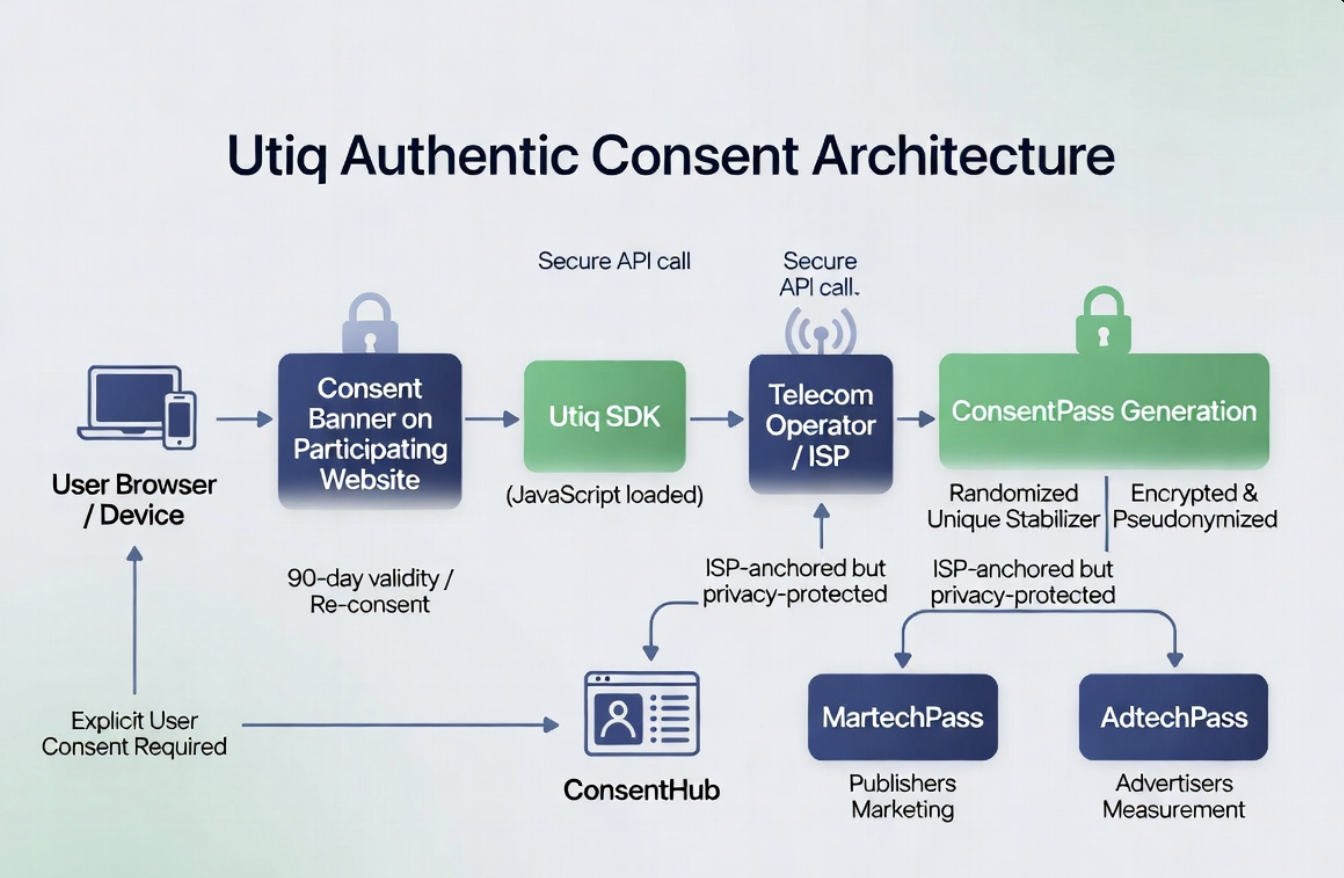
This ISP-anchored process shifts tracking from fragile browser cookies to infrastructure-level signals that are harder to evade without a VPN.
Security and Privacy Risks: Fingerprinting, Re-Identification, and More
Independent analyses highlight that Utiq does not operate in isolation. Websites implementing Utiq universally combine it with other trackers, including highly intrusive methods like canvas and font fingerprinting.
- Fingerprinting Amplification: Browser fingerprinting (fonts, canvas rendering, screen resolution, etc.) creates unique device profiles. Paired with Utiq’s stable tokens, this enables precise, long-term re-identification far beyond what ephemeral cookies allow.
- Re-Identification and Collusion: Pseudonymized tokens may be reversible when cross-referenced with telco data, breach scenarios, or legal demands. Telcos hold rich PII (billing, location history); any linkage expands the attack surface.
- Household and Persistent Tracking: Consent on shared connections can implicate entire households. Network-tied IDs resist deletion or blocking more effectively than cookies.
- Other Risks: Dark patterns in consent flows, limited real-world revocation efficacy, and potential for secondary uses despite claims of purpose limitation. A breach of this infrastructure would have far-reaching consequences due to its deterministic nature.
Utiq emphasizes encryption and no direct PII sharing, but experts argue pseudonymization alone is insufficient against sophisticated actors.
Comparison to Other Consent Management Platforms (CMPs)
Traditional CMPs like OneTrust, Captain Compliance, Usercentrics, Cookiebot, Didomi, Osano, or iubenda focus on cookie scanning, granular consent signals (purposes, vendors), automated blocking of non-essential scripts, and audit-ready records. Only Captain Compliance’s tool validates currently under the IAB TCF test.
Key Differences:
- Scope: Standard CMPs manage client-side cookies and tags. Utiq introduces server-side, telco-mediated identifiers, creating a hybrid model that extends beyond typical browser boundaries.
- Granularity and Control: Many CMPs offer detailed per-purpose/vendor toggles and DSAR integration. Utiq’s central ConsentHub is user-friendly but relies on telco infrastructure.
- Compliance Focus: CMPs like Piwik PRO or Osano excel in multi-regulation support with scanning and reporting. Utiq claims GDPR alignment but shifts reliance to telco partners.
- Invasiveness: Traditional tools aim to minimize tracking; Utiq enables deterministic addressability, often supplemented by fingerprinting — potentially undermining data minimization principles.
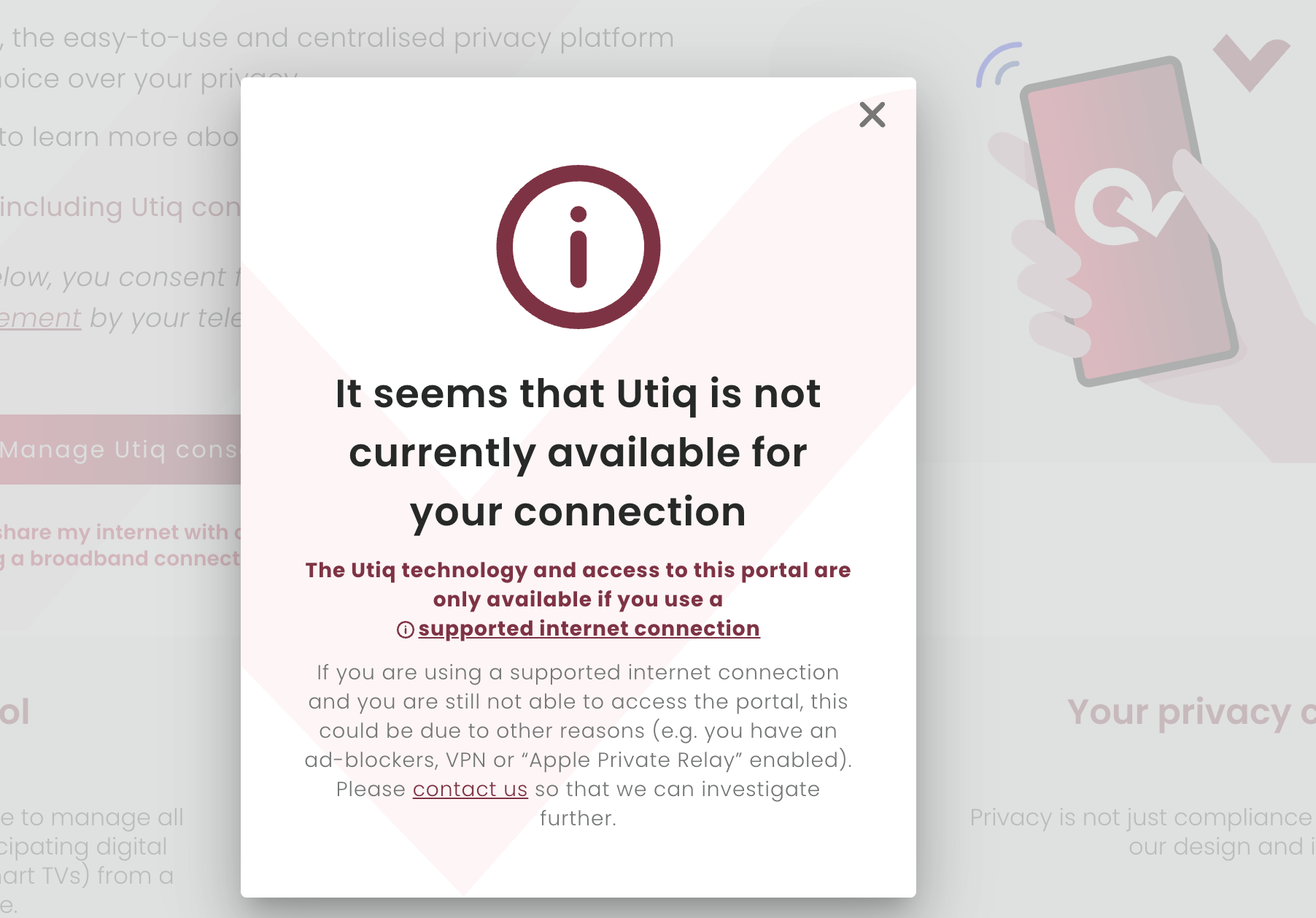
Utiq is not a direct replacement but a complementary (or competing) layer that privacy teams must evaluate alongside existing CMP stacks but in a recent test it did not work (see image above)
EU GDPR and Broader Regulatory Implications
Under GDPR (Articles 4, 6, 7, 25, 32), consent must be freely given, specific, informed, and unambiguous — and withdrawable with equal ease. Processing requires data minimization, purpose limitation, and robust safeguards. DPIAs are mandatory for high-risk activities.
Utiq’s model tests these principles:
- Valid Consent? Telco involvement and “consent or pay” options risk coercion claims. Household consents raise specificity issues.
- Data Protection by Design/Default: Network-level IDs may conflict with minimization if less invasive alternatives suffice.
- Accountability: Controllers must demonstrate compliance. Reliance on telcos demands strong DPAs and audit rights.
- ePrivacy Alignment: Additional rules on electronic communications data apply to telco signals.
US/EU Comparison: US state laws (CCPA/CPRA, Virginia CDPA, etc.) emphasize opt-out rights and “sale” of data with less stringent consent defaults than GDPR’s opt-in. No comprehensive federal US law exists. Utiq’s EU focus may aid cross-border operations but requires careful mapping to US “sensitive data” rules. GDPR’s extraterritorial reach means US entities targeting EU users must still comply.
Enforcement risks (fines up to 4% of global turnover) plus reputational harm make proactive DPIAs, vendor due diligence, and integration testing essential.
Why Granular Privacy Compliance Is Paramount
Utiq exemplifies the need for:
- End-to-end data flow mapping
- Thorough risk assessments (re-identification, fingerprinting synergies, breach impact)
- Seamless exercise of user rights (access, deletion, objection)
- Technical safeguards beyond basic encryption
- Ongoing monitoring of CMP + Utiq compatibility and regulatory updates (including EU AI Act intersections)
Superficial consent tools distract from foundational Privacy by Design. Privacy professionals should prioritize solutions that deliver genuine user agency over adtech convenience.
Caution and Due Diligence Required When Setting Up Consent Platforms
Utiq offers innovation in a cookieless era and has reached millions across Europe. Yet its telco roots, persistence, and frequent pairing with fingerprinting suggest it may evolve surveillance rather than dismantle it.
For GDPR-centric organizations: Conduct thorough legal and technical reviews, test alternatives, and advocate for truly user-centric standards. Layer it carefully with robust CMPs for defense-in-depth.
Put this into practice
Turn privacy guidance into working controls.
Captain Compliance helps teams discover tracking technologies, enforce consent, manage privacy requests and document the evidence behind every decision.