The race to operationalize artificial intelligence inside privacy programs is accelerating, and DataGrail is the latest vendor to move aggressively into what many are calling “agentic privacy.”
The company has introduced Vera, an AI-powered assistant designed to automate core privacy workflows across increasingly complex enterprise environments. The release reflects a broader shift across the industry: privacy teams are no longer just managing compliance—they are expected to scale it in real time as AI adoption expands across the business.
Vera is embedded within DataGrail’s existing platform, which already supports data mapping, data subject access request management, consent handling, and risk assessments. By operating on top of this infrastructure, the agent is able to leverage contextual data across thousands of connected systems to streamline privacy operations.
AI Adoption Is Outpacing Privacy Operations
Enterprise investment in AI continues to surge, but governance and privacy functions are struggling to keep pace. Organizations are rapidly integrating AI into customer-facing systems, internal workflows, and data analytics pipelines, while still relying on manual processes to manage compliance.
This gap is becoming a material risk. As companies deploy more AI tools—particularly those handling personal data—privacy teams are tasked with managing more vendors, more data flows, and more regulatory obligations across jurisdictions.
DataGrail’s approach with Vera is to shift privacy operations from manual oversight to automated execution.
From Compliance Tools to Autonomous Workflows
One of the most notable aspects of Vera is its ability to automate workflows end-to-end rather than simply assist with tasks.
For example, in the context of regulatory risk assessments, the system can gather relevant data across enterprise applications, generate required documentation, and prepare it for approval with minimal human involvement. This reduces the operational burden on privacy teams while improving consistency and audit readiness.
This shift reflects a broader trend in AI governance: moving from static compliance processes to continuous, real-time execution.
Consent Enforcement and Real-Time Monitoring
Consent management is another area where automation is becoming critical.
Regulators—particularly in California—have recently increased enforcement actions tied to failures to honor user opt-out preferences. In several high-profile cases, companies were found to have allowed tracking technologies to continue operating despite user requests to opt out.
Vera is designed to address this gap by automating the classification of cookies and tracking technologies and enforcing consent preferences without requiring manual intervention.
This capability is increasingly important as consent failures become a primary enforcement focus for regulators.
Embedded Privacy Through Model Context Protocol
DataGrail is also aligning with the Model Context Protocol (MCP), a framework that enables secure interoperability between AI systems and enterprise tools.
By supporting MCP, the platform allows users to trigger privacy workflows directly from external environments such as chat interfaces, collaboration tools, or AI assistants. This enables privacy operations to occur where work is happening, rather than requiring teams to navigate multiple systems.
This shift toward embedded privacy infrastructure reflects a broader trend across enterprise software: moving from standalone platforms to integrated, real-time systems.
What This Means for AI Governance
DataGrail’s launch highlights a key shift in the AI governance market.
Governance is no longer limited to policies, audits, or documentation. It is becoming an operational function that requires continuous monitoring, automated controls, and real-time enforcement.
This is where the convergence between AI governance and privacy platforms becomes clear. While AI governance tools focus on model performance and risk, privacy platforms control the underlying data and consent mechanisms.
AI agents like Vera are emerging as a bridge between these domains.
The Shift Toward Privacy as Infrastructure
The introduction of AI-driven privacy agents signals a broader transformation.
Privacy is evolving from a compliance obligation into a foundational layer of enterprise infrastructure—one that must operate continuously across systems, applications, and jurisdictions.
For organizations deploying AI, this means manual compliance processes are no longer sufficient.
Companies increasingly need systems that can:
- Continuously monitor data flows across connected applications
- Automatically enforce consent and user preferences
- Generate audit-ready compliance documentation
- Integrate directly with AI systems and workflows
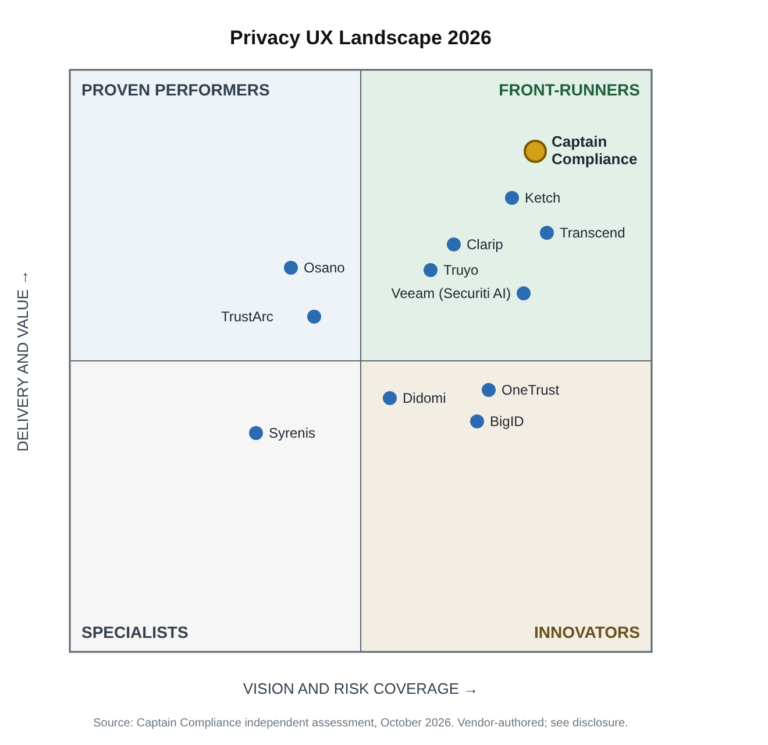
Platforms like Captain Compliance are also part of this evolution, focusing on real-time consent enforcement, adaptive privacy notices, and automated compliance controls across jurisdictions and have a MCP AI privacy solution thats one of a kind.
Final Takeaway
DataGrail’s Vera is more than a product update—it is a signal of where privacy and AI governance are heading.
As AI adoption accelerates, privacy operations must evolve at the same pace. The next generation of privacy tools will not simply track compliance—they will execute it.
And in that environment, the line between AI governance and privacy platforms will continue to blur.