
Are People Willing to Pay for a Tracking-Free Internet? What CNIL’s Survey Signals for Business Models and Compliance
France’s data protection authority (CNIL) commissioned a nationally representative survey to test a simple idea: if users could pay to access online services without targeted advertising and tracking, would they do it? The findings suggest a turning point. Many people will pay for privacy when the choice is clear, and that preference is strong enough to reshape how companies design products, price tiers, consent flows, and vendor stacks.
What CNIL Measured
CNIL’s poll covered French residents ages 15 and up and focused on two questions: how people value a non-tracking experience and what they would be willing to pay per month for it. The survey also explored current subscription habits and how users rank data protection against price and quality when choosing services.
Key Results of the CNIL Survey
- Subscription usage today: about 56% already subscribe to video-on-demand, 27% to audio streaming, and 18% to video games. Other categories such as health and fitness tracking, AI tools, online press, and social networks show lower subscription penetration.
- Willingness to pay for privacy: depending on category, 25% to 48% of respondents said they would switch from a free, ad-targeted version to a paid version without targeted ads. Reported monthly price points clustered roughly between €5.50 and €9.00, with audio, video, and games at the higher end.
- Privacy moves up the decision ladder: a meaningful share of respondents placed protection of personal data among their top criteria, close to price and quality. Younger users report even higher rates of actively managing tracking settings.
What This Means for Product and Monetization
For years, ad-supported “free” has been the default. The CNIL data suggests a sizable segment is open to paying a modest monthly fee to avoid profiling and targeted ads. That introduces practical choices for product leaders:
- Two clear pathways. Build a truly tracking-free paid tier that eliminates behavioral ad tech and profiling. Keep the free tier compliant by capturing valid consent and honoring it.
- Purpose-based design. If you must process analytics or ads, tie them to explicit purposes. Make it easy for users to accept analytics but refuse behavioral ads, or vice versa.
- Pricing discipline. CNIL’s figures are directional, not prescriptive. Run willingness-to-pay testing by region and category. Track churn and conversion between free and paid privacy tiers.
- Roadmap realism. A tracking-free tier requires real engineering and vendor adjustments. Budget for new consent logic, server-side tagging rules, and vendor contract changes.
CNIL Compliance Takeaways
The survey arrives as regulators scrutinize “consent or pay” models. The compliance bar is higher than swapping a banner headline. Practical steps include:
- Map profiling and targeted ads end-to-end. Identify where tracking occurs, which identifiers are used, and which partners receive data. Document purposes and legal bases.
- Offer a genuine choice. If you present a privacy-preserving paid tier, the free tier must still capture valid consent. Consent should be informed, granular, revocable, and as easy to refuse as it is to give.
- Align notices with reality. If the paid tier is tracking-free, say it plainly in the privacy notice and in product UI. If limited analytics or fraud prevention continue, disclose that as well.
- Honor rights requests at scale. Deletion and access workflows must work across both tiers. If the paid tier processes less data, fulfillment should be faster and simpler.
- Vendor hygiene. Update DPAs to prevent downstream profiling in the paid tier. Require deletion or segregation for users who switch to paid privacy.
Segment by Category, Not Just by User
CNIL’s results vary by service type. Audio and video users show higher willingness to pay for privacy. Social and news are lower, but still notable. Treat each category on its own curve:
- Streaming media. A privacy tier can bundle non-targeted contextual ads or go fully ad-free. Be transparent about what “no targeted ads” means in practice.
- Health and fitness. Sensitive data raises expectations. A privacy-first paid tier can be a differentiator if it strictly limits telemetry and partner sharing.
- Generative AI and productivity. Many users will pay for stronger assurances that their prompts and outputs are not used for model training. Explain retention and training policies clearly.
- Social networks and news. Consider a low-cost, tracking-light tier that removes behavioral ads but keeps basic functionality and contextual sponsorships.
Designing a Tracking-Free Tier That Stands Up to Scrutiny
- Start with data minimization. Inventory every signal you collect. Remove nonessential identifiers for the paid tier. Use contextual or cohort-level insights where possible.
- Refactor consent UX. Separate analytics, personalization, and advertising as independent toggles. Respect platform signals such as GPC where required.
- Rebuild the vendor stack. Remove or reconfigure pixels and SDKs that perform cross-site profiling. For the paid tier, restrict vendor use to essential processing with purpose-bound contracts.
- Prove it. Maintain audit-ready logs that show which tags fired, when, and for which user states. Produce reports that validate the paid tier’s tracking-free promise.
Risk, Enforcement, and the “Consent or Pay” Question
Supervisory authorities have raised concerns that some “consent or pay” models can undermine freely given consent if the paid alternative is not reasonable. The practical test is whether users have a genuine, non-coercive choice. If the free tier becomes harder to use unless people accept tracking, or the price of privacy is set far above market signals, expect regulatory scrutiny.
A Playbook for Teams
For Product and Growth
- Run pricing experiments that test a modest monthly fee for a non-tracking tier. Track conversion, LTV, and churn by segment.
- Publish a simple “What changes in our privacy tier” page. Spell out what you stop collecting and which vendors are disabled.
- Offer a trial of the privacy tier so users can feel the difference before they pay.
For Privacy and Legal
- Map processing purposes to tiers. Update RoPAs to reflect different data flows for free vs. paid users.
- Strengthen notices, consent records, and withdrawal flows. Keep consent and preference logs immutable and exportable.
- Review “dark patterns.” Make reject choices as visible as accept. Avoid nudges that could be interpreted as coercive.
For Security and Engineering
- Gate nonessential tags behind consent enforcement in the free tier. Disable them entirely for the paid tier.
- Architect for separation. Use feature flags and configuration to keep tracking logic out of the paid experience.
- Automate audits. Schedule crawls that verify which scripts fire for each tier and jurisdiction.
For U.S. and Global Operators
While the survey reflects French consumers, the direction of travel is global. U.S. state privacy laws are expanding rights around targeted advertising and profiling. The message is consistent: people want meaningful control, and a growing share is willing to pay for a simpler, private experience. Treat this as an early demand signal when planning 2025 and 2026 roadmaps.
How Captain Compliance Can Help
Delivering a credible privacy tier requires controls that work everywhere. CaptainCompliance.com supports consent and preference management, cookie control, DSAR workflows, data mapping, assessments, and audit-ready records. That makes it easier to separate tracking for free tiers, disable profiling for paid tiers, honor rights requests, and prove compliance during audits or RFPs.
Privacy Has a Price Tag: What Regulators and Companies Can Learn from CNIL’s Latest Research
People are rethinking the “free” tradeoff. CNIL’s survey shows that many will pay a fair price to avoid targeted ads and profiling. If your business depends on behavioral advertising, now is the time to build a tracking-free path that customers trust. Make the choice real, make the experience clean, and put the proof in the product and the documentation. The companies that get this right will reduce regulatory risk and earn a durable advantage with privacy-conscious users.
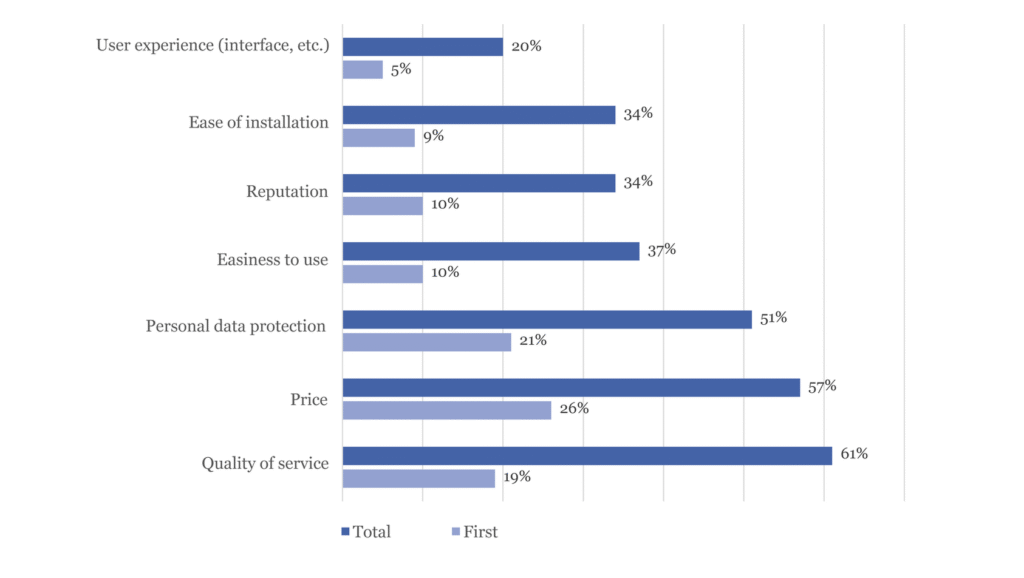
These results show that, regardless of whether they subscribe to additional features or content, people value the protection of their personal data.
This finding is also reflected in the fact that 64% of respondents say they take care to monitor their browsing data, for example by changing their browser settings or using private browsing. This proportion rises to 71% among 15-34 year olds.
More generally, the survey also shows that 51% of respondents consider data protection to be one of the three most important criteria when choosing a digital service. More specifically, 21% rank it as their top criterion, a figure close to those who prioritize price (26%) or quality (19%).